
Table of Contents
Do you want to relieve your sore back muscles or ease post-workout stiffness with a massage gun? Then you’re in the right place! We’ve put together a guide on how to use a massage gun the proper way—whether you’re an athlete or just looking for muscle relief. Learn the basic rules and key techniques to improve recovery, loosen tight muscles, and support your lymphatic system.
What is a massage gun?
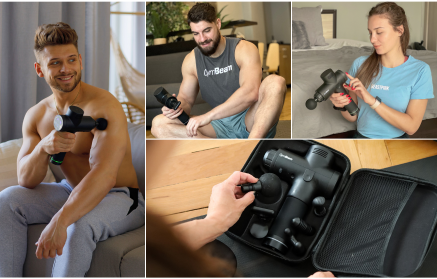
A massage gun is a portable device that works on the principle of percussive therapy. This technique uses rapid oscillating movements that penetrate deep into the muscle tissue. It helps promote blood circulation, delivering oxygen and nutrients to the muscles, while also aiding in the removal of waste products. As a result, it contributes to faster recovery, pain reduction, increased range of motion, and may even help reduce the appearance of cellulite.
These self-massage devices come in various sizes, shapes, and designs. The most popular are the classic (powerful) or compact (mini) massage guns. Both typically offer multiple intensity levels and come with several massage head attachments, which you can choose based on the body part you want to focus on. If you pick a high-quality model with enough power, a massage gun can also be suitable for back pain and other areas of the body. [1–2]
Everything about the benefits of massage guns can be found in the article: Massage Guns: 5 Ways They Can Benefit Everyone, Not Just Athletes

How to Choose a Massage Gun?
If you’re thinking about getting a massage gun, consider these factors:
- Power and Intensity: Check if the massage gun has adjustable intensity levels to suit different massage needs.
- Noise Level: Some massage guns can be noisy, which can be disruptive. Look for models with quiet operation for a more comfortable experience.
- Battery Life: The runtime on a single charge is crucial, especially if you plan to use it for longer or more frequent sessions.
- Weight and Ergonomics: Lighter and ergonomically designed models are easier to handle and allow for longer use without hand fatigue. Mini massage guns are more portable, which makes them ideal for travel.
- Accessories and Attachments: Different massage head attachments are designed for specific muscle groups. Make sure the chosen model includes attachments that suit your needs.
Basic attachments for massage guns
- Round (Ball) Attachment: Back, shoulders, arms, hips, glutes, quadriceps, hamstrings, calves.
- Fork Attachment: Areas with tendons and ligaments, such as along the spine or shins.
- Flat Attachment: Back, chest, forearms.
- Bullet Attachment: Trigger points, deep muscle tissue.
- Golden Finger Attachment: Trapezius muscle, deep muscle tissue.
- Wedge Attachment: Area of the spine, shoulder blades, shins.

7 Key Tips for Using a Massage Gun Correctly
Before you start using the massage gun, make sure to familiarize yourself with the basic safety guidelines. This will help you avoid unwanted effects, such as bruising of muscles or bones, and ensure you use it effectively. [3–4]
- Choose the right massage head attachment: Select the attachment shape based on the area you want to massage.
- Choose the intensity: Start at a lower speed and gradually increase to higher levels.
- Find a comfortable position: Lie down or sit in a way that feels comfortable and allows the muscle being massaged to relax.
- How often and for how long to use a massage gun: Massage one area for 30 seconds to 2 minutes. Throughout the day, you can repeat the massage of one area 1–2 times. Overall, limit your total massage time to 15–20 minutes per day.
- Massage only muscles: Avoid the head, neck, bones, joints, spine, and areas with bruises or other injuries.
- Be aware of contraindications: When should you not use a massage gun? If you have inflammatory diseases, thrombosis, varicose veins, neurological conditions, high blood pressure, heart or musculoskeletal problems, or are taking blood-thinning medications. Make sure to consult your doctor about the suitability of using a massage gun. Women should avoid using a massage gun during pregnancy due to hormonal changes and the effect of massage on blood circulation.
- Use it at the right time: It’s suitable before and after a workout or anytime during the day. However, avoid using it immediately after intense strength training, a long run or other endurance activities.
You might be interested in these products:
12 Effective Massage Gun Techniques for the Whole Body
Are you looking to get a full-body massage or just focus on problem areas like the traps or back? We’ve put together a list of the best tips and techniques with a massage gun for both the upper and lower body. You can create your own massage routine and do it comfortably at home. However, if you need a more thorough massage, especially for your back, ask your partner or a family member to help.
1. Trapezius Massage
- Starting Position: Sit on a mat in a comfortable position, such as cross-legged. Grab the massage gun with one hand and attach the round massage head.
- Execution: Turn on the massage gun and set it to a low intensity, gradually increasing as needed. If you’re holding the massage gun in your right hand, start massaging the left trapezius, and vice versa. Place the massage head attachment on the muscle and massage the area between the shoulder and neck. Focus only on the muscle, avoiding the collarbone and neck. Massage one side first, then switch to the other.
- Other suitable attachments: Bullet, Golden Finger.
- Tip: Try massaging your traps after a long day at the computer, a mentally exhausting day, or a trip with a heavy backpack.

2. Shoulder Massage
- Starting Position: Sit on a mat in a comfortable position, such as cross-legged. Grab the massage gun with one hand and attach the round massage head.
- Execution: Turn on the massage gun and set it to a low intensity, gradually increasing as needed. If you’re holding the massage gun in your right hand, start massaging your left shoulder, and vice versa. Place the attachment on the muscle and use circular motions to massage the deltoid muscle. Focus only on the muscle, avoiding the shoulder joint. Massage one side first, then switch to the other.
- Other suitable attachments: Flat, Bullet.
- Tip: Try massaging your shoulders some time after an upper body workout, swimming, volleyball, basketball, or racket sports.

3. Biceps Massage
- Starting Position: Sit on a mat in a comfortable position, such as cross-legged. Grab the massage gun with one hand and attach the flat massage head.
- Execution: Turn on the massage gun and set it to a low intensity, gradually increasing as needed. If you’re holding the massage gun in your right hand, start by massaging your left arm. Rest it on your leg to relax and gently bend it at the elbow. Place the massage head attachment on the bicep and begin massaging with circular motions. Focus only on the muscle, avoiding the humerus, elbow crease, and elbow. Massage one arm first, then switch to the other.
- Other suitable attachments: Round, Bullet.
- Tip: Try massaging your biceps some time after an upper body workout, racket sports, climbing, or rowing.

4. Triceps Massage
- Starting Position: Sit on a mat in a comfortable position, such as with your legs bent in front of you. Grab the massage gun with one hand and attach the flat massage head.
- Execution: Turn on the massage gun and set it to a low intensity, gradually increasing as needed. If you’re holding the massage gun in your right hand, start by massaging your left arm. Rest it in front of you on the ground or on your leg to relax, and gently bend your elbow. Place the attachment on the triceps and begin massaging with circular motions. Focus only on the muscle, avoiding the humerus and elbow. Massage one arm first, then switch to the other.
- Other suitable attachments: Round.
- Tip: Try massaging your triceps some time after an upper body workout, racket sports, climbing, cross-country skiing, or rowing.

5. Forearm Massage
- Starting Position: Sit on a mat in a comfortable position, such as with your legs bent in front of you. Grab the massage gun with one hand and attach the flat massage head.
- Execution: Turn on the massage gun and set it to a low intensity, gradually increasing as needed. If you’re holding the massage gun in your right hand, start massaging your left forearm. Gently bend your arm and rest your forearm on your thigh to keep the arm relaxed. Place the massage head attachment on the forearm and begin massaging with an upward motion, working from all sides. Focus only on the muscle, avoiding the radius and ulna bones. Massage one arm first, then switch to the other.
- Other suitable attachments: Round.
- Tip: Try massaging your forearms some time after an upper body workout, climbing, bouldering, or callisthenics (pull-up bar exercises).

6. Chest Muscle Massage
- Starting Position: Sit on a mat in a comfortable position, such as with your legs bent in front of you. Grab the massage gun with one hand and attach the flat massage head.
- Execution: Turn on the massage gun and set it to a low intensity, gradually increasing as needed. If you’re holding the massage gun in your right hand, start massaging the left side of your chest. Rest your left hand comfortably on your thigh or the mat in front of you. Place the massage head attachment on the pectoral muscle and begin massaging with circular motions or from bottom to top. Focus only on the muscle, avoiding the sternum, collarbone, breast tissue, and nipple area. Massage one side first, then switch hands and move to the other side.
- Other suitable attachments: Round.
- Tip: Try massaging your chest muscles some time after a bench press workout, push-ups, ring exercises, dips, or other chest exercises.

7. Lower Back Massage
- Starting Position: Sit on a mat with your legs bent and lean forward slightly. Grab the massage gun with one hand and attach the round massage head.
- Execution: Turn on the massage gun and set it to a low intensity, gradually increasing as needed. If you’re holding the massage gun in your right hand, begin massaging the right side of your lower back. Rest your left hand comfortably on your thigh or the mat in front of you. Place the massage gun attachment on the lower back (just above the hips) and begin massaging with an upward-to-downward motion, moving towards the hips. Focus only on the muscles, avoiding the spine and pelvic bone area. Massage one side first, then switch hands and move to the other side.
- Other suitable attachments: Flat.
- Tip: Try massaging your lower back after exercises like deadlifts or other movements targeting this area, or after overuse from long periods of standing, sitting, walking, or carrying heavy objects.

8. Glute Massage
- Starting Position: Lie on your back on the mat, bend one leg to about a 90-degree angle, and place it across the other leg. Then, place a foam roller, folded mat, or cushion under the knee of the bent leg. Grab the massage gun with one hand and attach the round massage head.
- Execution: Turn on the massage gun and set it to a low intensity, gradually increasing as needed. If you’re holding the massage gun in your right hand, start massaging your right glute. With your other hand, gently hold the knee of the bent leg. Place the attachment on the gluteal muscle and begin massaging with up-and-down or circular motions, targeting all sides of the muscle. Focus only on the muscle, avoiding the pelvic bone and tailbone. Massage one side first, then switch legs and repeat on the other side.
- Other suitable attachments: Flat, Bullet.
- Tip: Try massaging your glutes after exercises like squats, deadlifts, hip thrusts, and other glute-focused workouts, or after a long run or uphill walk.

9. Front and Inner Thigh (Quadriceps) Massage
- Starting Position: Sit on the mat, bend one leg at a 90-degree angle, and place the knee on the ground. Keep the other leg extended on the mat. Grab the massage gun with one hand and attach the round massage head. Use the other hand to support yourself behind you for better stability.
- Execution: Turn on the massage gun and set it to a low intensity, gradually increasing as needed. Start massaging the front of the thigh (quadriceps) of the bent leg. Move from the knee towards the hip, covering the entire length and width of the quadriceps. Massage only the muscle, avoiding the kneecap and knee joint. First, massage one leg, then switch and move on to the other.
- Other suitable attachments: Flat, Bullet.
- Tip: Try massaging your thighs some time after a workout of squats, machine hip abductions, or other leg exercises, after a long run, cycling, or team ball and racket sports.

10. Hamstring Massage
- Starting Position: Sit on the mat, bend one leg at approximately 90 degrees, keeping the foot on the ground and the knee pointing upwards. Keep the other leg extended on the mat. Grab the massage gun with one hand and attach the round massage head. Use the other hand to support yourself behind your body for greater stability.
- Execution: Turn on the massage gun and set it to a low intensity, gradually increasing it as needed. Begin massaging the hamstring of the bent leg, moving from the bottom upwards towards the glute, covering the entire length and width of the muscle. Focus exclusively on the muscle, avoiding the area behind the knee. Massage one leg first, then switch and repeat on the other.
- Other suitable attachments: Flat, Bullet.
- Tip: Try massaging the hamstrings with a time gap after exercises such as Romanian deadlifts, leg curls on the machine, and other movements targeting the back of the thighs, as well as after a long run, cross-country or downhill skiing, snowboarding, or team ball and racket sports.

11. Outer Thigh Massage
- Starting Position: Sit on the mat with your knees slightly bent and your feet flat on the floor. Grab the massage gun with one hand and attach the round massage head. With your other hand, either hold onto one leg or place it behind you for added stability.
- Execution: Turn on the massage gun and set it to a low intensity, gradually increasing it as needed. Start by massaging the outer side of the thigh. Move from the hips down the side of the leg towards the knee. Focus solely on the muscle, avoiding the hip and knee joints. Massage one leg first, then switch to the other.
- Other suitable attachments: Round.
- Tip: Try massaging the outer side of the thigh with a time gap after exercises such as abduction machine workouts and other movements targeting the outer thigh, as well as after a long run, skating, cross-country or downhill skiing, or team ball and racket sports.

12. Calf Massage
- Starting Position: Sit on the mat with your knees slightly bent and your feet flat on the floor. Grab the massage gun with one hand and attach the round massage head. With your other hand, you can either hold onto one leg or place it behind you for added stability.
- Execution: Turn on the massage gun and set it to a low intensity, gradually increasing it as needed. Place the massage head attachment on the calf and begin massaging. Move from the ankle upwards towards the knee pit. Focus solely on the muscle, avoiding the ankle and knee joints. Massage one leg first, then switch to the other.
- Other suitable attachments: Flat, Bullet, Fork.
- Tip: Try massaging the calves with a time gap after exercises such as calf raises and other calf-focused movements, as well as after a long run, cross-country or downhill skiing, or team ball and racket sports.

Where to Go From Here?
Make sure to also explore other recovery techniques in our additional articles.
- The foam roller is also a popular tool for recovery. You can find out more about its benefits in the article: Foam Roller: Why and How to Use This Massage Tool?
- The best exercises with a foam roller can be found in the article: How to Use a Foam Roller? Top 8 Foam Roller Exercises
- You can learn about different recovery methods in the article: The Best Techniques for Regeneration, Muscle Soreness and Fatigue After Training
- We also cover massage tools in more detail in the article: How to Support Regeneration Using a Massage Gun and Other Tools?
- You can also support your recovery with our 10 tips on how to best recover your body after a workout.
What Are the Main Takeaways?
The massage gun is an effective device for relieving muscle tension and aiding recovery across the whole body. The aforementioned basic techniques are useful not just for athletes, but also for anyone who needs to ease back pain after long periods of sitting. To get the best results, remember a few simple guidelines: massage each muscle group for at least 30 seconds to 2 minutes, gradually increase the intensity, and only use it on muscles.
Did you find this article helpful? If so, feel free to share it with your friends and pass along the tips for using a massage gun.
[1] Brownlee, D. T. Massage guns: Much-needed recovery tool or money for nothing?– https://www.scienceforsport.com/massage-guns-much-needed-recovery-tool-or-money-for-nothing/
[2] EverydayHealth.Com. Massage Guns: Do They Work and Are They Worth It?– https://www.everydayhealth.com/fitness/everything-you-need-to-know-about-massage-guns/
[3] MOMT, J. P., PT. 11 Benefits of Massage Guns: Pros and Cons.– https://petersenpt.com/11-benefits-of-massage-guns-pros-and-cons
[4] Maddison, S. Massage Gun Guidelines.– https://www.physiotherapychelmsford.co.uk/massage-gun-guidelines/
Add a comment