

Table of Contents
Magnesium is associated by most people with better sleep, relaxation, or relief from unpleasant muscle cramps. Overall, it is involved in more than 300 processes in our body. For many years, this mineral has had a reputation as a “calming agent” used in sports and healthy nutrition. However, the scientific community began to pay attention to another, much more aggressive aspect of this element.
During a detailed examination of elite athletes, scientists noticed an interesting and almost unmissable phenomenon: men with higher magnesium levels almost always had higher testosterone levels. So, what if magnesium is a silent enhancer of male vitality? Or is it all just a consequence of the body not functioning as it should when magnesium is deficient? Just as with vitamin D, the answers here cannot be reduced to a simple yes or no. What lies between the lines, however, is surprisingly fascinating. Come with us to uncover the secret of a connection you might not even have suspected.
Scientists: 4-Week Magnesium Supplementation Increased Testosterone Levels
A team of scientists led by Vedat Cinar published a study in the respected scientific journal Biological Trace Element Research that clarified the view on the relationship between minerals and anabolic hormones. Their goal was clear: to determine whether magnesium can increase testosterone levels and whether physical activity influences this. [1]
How was the experiment conducted?
The researchers divided participants into three specific groups:
- Sedentary group (non-athletes): men without regular training who took magnesium.
- Athletes (Taekwondo): trained athletes who worked out 90–120 minutes daily and also took magnesium. Specifically, it was Taekwondo training.
- Control group of athletes: athletes who trained Taekwondo but did not take magnesium.
Participants took a high dose of 10 mg of magnesium per 1 kg of body weight daily and were monitored for 4 weeks.

Surprising results of the relationship between testosterone and magnesium
After a month of measurements, scientists came to clear conclusions that will please not only athletes but also ordinary men:
- Testosterone growth in all: Both free and total testosterone levels increased in both groups that took magnesium (athletes and non-athletes).
- Synergy with movement: The most significant increase was observed in group no. 2 – those who combined training with magnesium supplementation.
- Performance: The increase in testosterone was most visible in a state of exhaustion (after training), suggesting that magnesium helps the body better cope with the stress of physical exertion.
Key finding: magnesium was able to increase testosterone even in men who did not exercise. However, in combination with intense training, it acted as a powerful catalyst that maximised the body’s anabolic response.

Why does it work?
To understand how a mineral can affect a hormone, we need to delve a little deeper into biochemistry. But don’t worry, we won’t be going through the periodic table or stressing over school lessons. We will be primarily interested in the easily memorable term sex hormone-binding globulin or SHBG (Sex Hormone Binding Globulin). This is where the most interesting battle for your male strength takes place.
Many men focus only on total testosterone. However, that is only one side of the coin. You can have a huge amount of testosterone in your body, but if your body cannot use it, it is useless to you. Imagine SHBG as handcuffs circulating in your blood. These handcuffs have only one task – to catch a testosterone molecule and firmly lock it up. But what happens to such testosterone?
You might be interested in these products:
Bound vs. Free Testosterone
- Bound testosterone: is biologically inactive. It floats in the blood but cannot bind to androgen receptors in the muscles. In such a case, it is unusable for building muscle mass.
- Free testosterone: is exactly the ace you want. It is not restricted by imaginary handcuffs, it can freely enter cells and initiate the process of growth and regeneration.
And this is where magnesium comes into play, which has the ability to bind to SHBG. When there is enough magnesium in the blood, this mineral “sacrifices” itself for testosterone and allows itself to be bound instead. By occupying a place in the “handcuffs” (SHBG), your body has more free testosterone. The result is the same total hormone level, but much higher bioavailability for your muscles and performance. And that’s what you want, isn’t it? [2]

So, is magnesium a miraculous testosterone booster?
Although scientific knowledge may seem like the holy grail for muscle gain at first glance, it is necessary to read between the lines. To avoid oversimplifying the issue, we must ask a critical question:
What is the relationship between magnesium and testosterone based on?
Two essential things are important in this case:
1. Baseline level factor
Many ordinary people, and especially active athletes, suffer from subclinical magnesium deficiency. If the study participants had low magnesium levels at the beginning, supplementation only removed the brake that kept their testosterone in check. It’s like a sports car with insufficient oil – the engine struggles, overheats, and cannot deliver its maximum performance. When the oil is topped up, everything runs smoothly again. On the other hand, this does not mean that the more oil you add to the car, the more the engine’s performance will increase. The same applies to our body and magnesium.
2. Extreme dosage
The study participants took 10 mg of magnesium per 1 kg of body weight. For a 90-kilogram man, this means 900 mg of magnesium daily, which is more than double the usual recommended daily dose (approx. 300–400 mg). Such high doses suggest that scientists wanted to aggressively saturate cells with magnesium to demonstrate the effect. In everyday life, however, they should not be tried. Although magnesium overdose is rare in healthy people (the kidneys excrete the excess), high doses of poor-quality forms can cause undesirable side effects. The most common are diarrhoea and abdominal cramps.
Magnesium simply does not work like a steroid that would push you beyond your genetic limits. Its strength lies in optimisation, and given that many people are deficient in magnesium, for most men, magnesium supplementation will lead to a real and noticeable improvement in their hormonal profile.
For which groups of men does magnesium supplementation make the most sense?
Magnesium can make sense in connection with testosterone, mainly for two specific groups of men:
1. Athletes and manual labourers
Because physical exertion is a double-edged sword. On the one hand, it stimulates muscle growth, on the other hand, it enormously depletes our mineral reserves. Athletes lose and consume a significant amount of magnesium through sweating and muscle work. For this group, supplementation is crucial. Not for artificial increase, but rather for maintaining high testosterone levels. If the body lacks fuel in the form of any important substance, it switches to economy mode and suppresses the production of anabolic hormones. [3]
2. Men with poor sleep quality
Because lack of sleep is the biggest killer of testosterone (it increases the stress hormone cortisol, which competes with testosterone). Magnesium is known for its ability to calm the nervous system and improve sleep quality. The equation here is simple: more magnesium → deeper sleep → better night regeneration of the hormonal system.[4–5]
Who is at risk of testosterone deficiency?
Risk groups of people who are at risk of testosterone deficiency include [6]:
- older men, because after the age of 30 to 40, testosterone levels in men begin to decline at an average rate of 1% to 2% per year [7]
- individuals who are overweight or obese, because adipose tissue, especially in the abdominal area, produces the enzyme aromatase, which directly converts testosterone to estrogen. This mechanism literally robs a man of his strength and triggers a vicious circle → low testosterone leads to fat storage, and more fat leads to even lower testosterone. [8]
- men with lower levels of physical activity, because their body has no reason to waste energy on maintaining high levels of anabolic hormones. Studies show that increased physical activity (especially strength training) directly correlates with increased testosterone levels, while a sedentary lifestyle suppresses it. [9]
- people with a low intake of nuts and green leafy vegetables, because they are rich in magnesium, also thanks to chlorophyll. In the common modern diet, often full of highly industrially processed foods, magnesium is woefully scarce. [10]
- alcohol consumers, because alcohol is one of the biggest enemies of magnesium reserves. It acts as a diuretic that directly blocks the reabsorption of magnesium in the kidneys. This means that instead of the body saving magnesium, alcohol forces it to be excreted in the urine. [11]
- people with high levels of stress, which increases cortisol, and that lowers testosterone. Magnesium, in this case, acts as a counterweight to stress -> it lowers cortisol, and thus protects testosterone.
How do I know if I have a magnesium deficiency?
Estimates suggest that a significant portion of the population has insufficient magnesium in their diet. There are also large differences between countries [15]:
- Italy: average intake is alarmingly low, only around 208 mg/day (well below the norm).
- France: 77% of men and 72% of women have a lower magnesium intake than the recommended daily allowance.
- Germany: men consume an average of 353 mg, women 288 mg (German men are relatively well off, women are just below the norm).
- Great Britain: research shows that the average intake in young adults (19–24 years) is often only around 220–250 mg, which is a significant deficit.
One solution is testing, but your body is also a good indicator, often showing magnesium deficiency. How?
Physical manifestations of magnesium deficiency include:
- Muscle twitching and cramps: classic eye twitch or muscle cramps (especially at night or after training).
- Chronic fatigue and weakness: because magnesium is key for ATP (energy) production, and without it, you’re essentially running at half power.
- Mental discomfort or, in other words, a short fuse, manifesting as irritability, anxiety, and inability to cope with stress.
- Sleep problems: when you can’t switch off your mind in the evening or wake up frequently. [12]
Which magnesium is best?
Regarding sources, the diet and foods rich in magnesium certainly remain the basis in this regard, such as:
| Food | Magnesium content per 100 g |
|---|---|
| Cashew nuts and cashew butter | 292 mg |
| Almonds and almond butter | 270 mg |
| Dark chocolate | 228 mg |
| Quinoa | 197 mg |
| Oatmeal | 177 mg |
| Beans | 171 mg |
| Peanuts and peanut butter | 168 mg |
However, if you are concerned that your diet is not sufficiently varied and rich in the mentioned foods, supplements will also be a great help.
Magnesium supplements
Forms
- capsules – a comfortable form that is easy to swallow and effectively masks the natural, often bitter taste of magnesium
- tablets – an alternative to capsules, often containing a high dose of magnesium
- powders – a well-soluble form that also allows flexible dosing and is often a great choice for people with problems swallowing solid forms
- effervescent magnesium – soluble tablets with a refreshing taste that also help maintain fluid intake
- microcapsules – a special form (also known as sustained-release capsules) that excels in its gradual and more effective absorption
- liquid (shots) – a liquid RTD form for your pocket, ready for immediate use without the need for drinking, which you will appreciate, for example, when travelling
Single-ingredient vs. complex magnesium
- single-ingredient (containing only magnesium)
- multi-ingredient (magnesium enriched with other substances for a specific purpose), such as magnesium B6 forte, ZMB, which contains a synergistic combination of magnesium, zinc, and vitamin B6. The combination of magnesium and zinc is important for testosterone production. You can read more about this combination in the article ZMA and ZMB Support Healthy Testosterone Levels and Sleep. What Other Benefits Can They Provide?
Absorbability (chemical bonds)
- Organic forms: excellent absorbability and gentleness on digestion. These include chelated bonds, such as bisglycinate or malate, as well as liposomal magnesium, magnesium threonate or citrate.
- Inorganic forms: poor absorbability. Typically oxides, carbonates, sulfates, or phosphates.
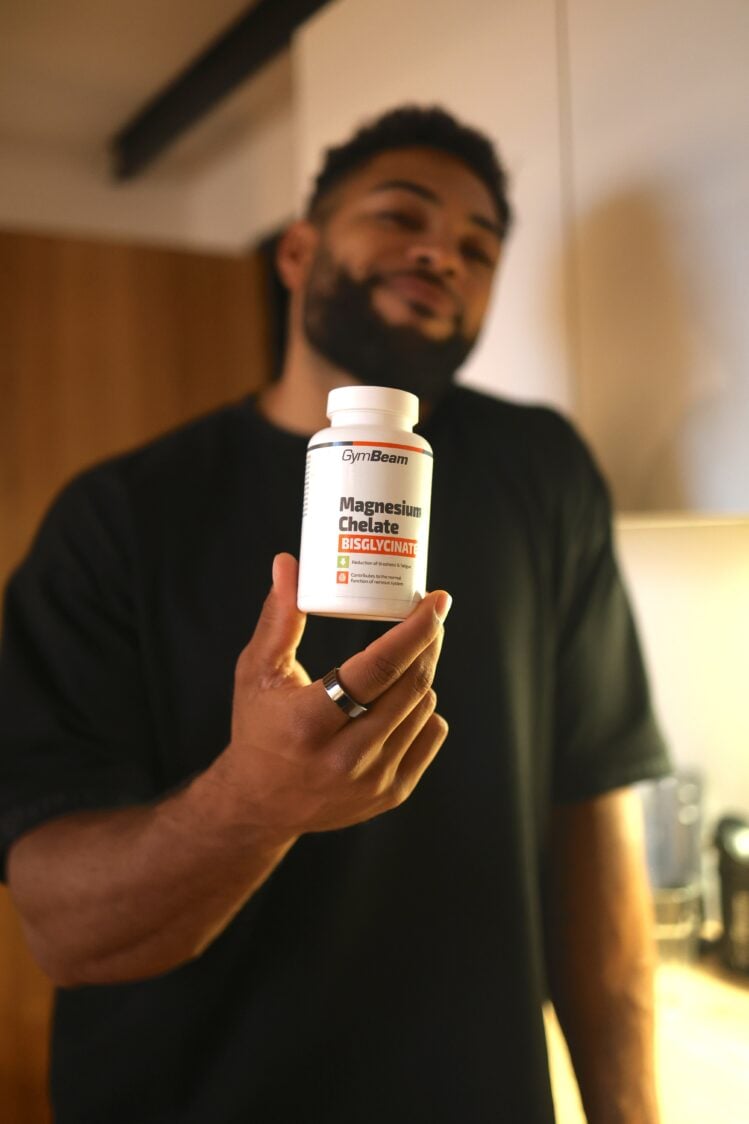
In terms of price/performance ratio, magnesium in chelated form is the best choice, such as magnesium bisglycinate. If you want to learn more about magnesium and testosterone, be sure to check out our articles:
- Cramps, Fatigue, Irritability or Sleep. What Else Does Magnesium Affect?
- How Does Magnesium Affect Sports Performance, Muscle Growth and Sleep?
- 10 Symptoms of Testosterone Deficiency – What Causes It and How to Treat It?
- Testosterone, Estrogen and Progesterone: How Do They Impact Weight Loss and Muscle Growth?
- What Is Turkesterone, How Does It Work and Can It Really Boost Testosterone Levels?
- Ecdysterone and its effect on muscle mass growth, strength, and testosterone levels
How much magnesium to take daily?
An average adult should consume approximately:
- 300 mg of magnesium daily (EFSA) [13]
- 310 mg for women and 400 mg for men (DACH) [14]
- during intense physical activity, the body’s magnesium requirements may increase by 10 – 20% [17]
When to take magnesium: morning or evening?
The specific time of day for magnesium intake does not matter. It is important to meet the total daily intake. Typically, however, magnesium malate is recommended to be taken in the morning or before training, and bisglycinate in the afternoon or before bedtime. And how long should magnesium be taken? Since it is involved in hundreds of processes and the body consumes it practically constantly, long-term use without breaks is suitable for active people.
Conclusion
If we were to summarise the entire issue of the relationship between magnesium and testosterone in one sentence, it would be: Magnesium is not a magic steroid, but it is an essential oil for your testosterone engine, which does not function optimally without it. While swallowing one magnesium capsule won’t turn you into the Hulk, science has clearly shown us that this mineral is one of the most underestimated tools for hormone optimisation.
Therefore, from this article, you should remember 3 key things:
- It acts as a key to freedom: Your body may produce enough testosterone, but if it’s bound by the SHBG protein, it won’t help your muscles. Magnesium can “unlock” these bonds and increase the level of usable (free) hormone.
- It’s a safety net for athletes: If you exercise, sweat, or live under stress, you lose magnesium at lightning speed. Supplementing it will get you back in the game and prevent the body from shutting down hormone production in crisis mode.
- Quality triumphs over quantity: Don’t try to consume extreme doses like in studies. Focus on long-term consistency. Include nuts and seeds, oats, dark chocolate or quality supplements (bisglycinates) in your diet and ensure optimal sleep.
Magnesium may not be the only key to male strength, but it is a solid foundation upon which everything else stands. Without it, even the best training plan and genetics may not be enough to reach your maximum potential.
[1] Vedat Cinar, Yahya Polat, Abdulkerim Kasim Baltaci, Rasim Mogulkoc – Effects of magnesium supplementation on testosterone levels of athletes and sedentary subjects at rest and after exhaustion – https://pubmed.ncbi.nlm.nih.gov/20352370/
[2] L Excoffon, Y C Guillaume, M C Woronoff-Lemsi, C André – Magnesium effect on testosterone-SHBG association studied by a novel molecular chromatography approach – https://pubmed.ncbi.nlm.nih.gov/19095394/
[3] F H Nielsen, H C Lukaski – Update on the relationship between magnesium and exercise – https://pubmed.ncbi.nlm.nih.gov/17172008/
[4] Rachel Leproult, Eve Van Cauter – Effect of 1 week of sleep restriction on testosterone levels in young healthy men – https://pubmed.ncbi.nlm.nih.gov/21632481/
[5] Behnood Abbasi, Masud Kimiagar, Khosro Sadeghniiat, Minoo M Shirazi, Mehdi Hedayati, Bahram Rashidkhani – The effect of magnesium supplementation on primary insomnia in elderly: A double-blind placebo-controlled clinical trial – https://pubmed.ncbi.nlm.nih.gov/23853635/
[6] Marcello Maggio, Francesca De Vita, Fulvio Lauretani, Antonio Nouvenne, Tiziana Meschi, Andrea Ticinesi, Ligia J Dominguez, Mario Barbagallo, Elisabetta Dall'aglio, Gian Paolo Ceda – https://pubmed.ncbi.nlm.nih.gov/24723948/
[7] S M Harman, E J Metter, J D Tobin, J Pearson, M R Blackman; Baltimore Longitudinal Study of Aging – Longitudinal effects of aging on serum total and free testosterone levels in healthy men. Baltimore Longitudinal Study of Aging – https://pubmed.ncbi.nlm.nih.gov/11158037/
[8] Mark Ng Tang Fui, Philippe Dupuis, Mathis Grossmann – Lowered testosterone in male obesity: mechanisms, morbidity and management – https://pmc.ncbi.nlm.nih.gov/articles/PMC3955331/
[9] Hiroshi Kumagai, Asako Zempo-Miyaki, Toru Yoshikawa, Takehiko Tsujimoto, Kiyoji Tanaka, Seiji Maeda – Increased physical activity has a greater effect than reduced energy intake on lifestyle modification-induced increases in testosterone – https://pubmed.ncbi.nlm.nih.gov/26798202/
[10] R Swaminathan – Magnesium Metabolism and its Disorders – https://pmc.ncbi.nlm.nih.gov/articles/PMC1855626/
[11] R S Rivlin – Magnesium deficiency and alcohol intake: mechanisms, clinical significance and possible relation to cancer development (a review) – https://pubmed.ncbi.nlm.nih.gov/7836619/
[12] Uwe Gröber, Joachim Schmidt, Klaus Kisters – Magnesium in Prevention and Therapy – https://pmc.ncbi.nlm.nih.gov/articles/PMC4586582/
[13] Scientific Opinion on the substantiation of health claims related to magnesium and electrolyte balance (ID 238), energy-yielding metabolism (ID 240, 247, 248), neurotransmission and muscle contraction including heart muscle (ID 241, 242), cell division (ID 365), maintenance of bone (ID 239), maintenance of teeth (ID 239), blood coagulation (ID 357) and protein synthesis (ID 364) pursuant to Article 13(1) of Regulation (EC) No 1924/2006 – https://efsa.onlinelibrary.wiley.com/doi/abs/10.2903/j.efsa.2009.1216
[14] EFSA – https://multimedia.efsa.europa.eu/drvs/index.htm
[15] G B M Mensink, R Fletcher, M Gurinovic, I Huybrechts, L Lafay, L Serra-Majem, L Szponar, I Tetens, J Verkaik-Kloosterman, A Baka, A M Stephen – Mapping low intake of micronutrients across Europe – https://pubmed.ncbi.nlm.nih.gov/23312136/
[16] FoodData Central – https://fdc.nal.usda.gov/index.html
[17] Marta R. Pardo M.Sc. a , Elena Garicano Vilar M.Sc. b, Ismael San Mauro Martín Ph.D., María Alicia Camina Martín – Bioavailability of magnesium food supplements: A systematic review – linkinghub.elsevier.com/retrieve/pii/S0899900721001568
Add a comment