

Table of Contents
Imagine that your body has an internal system that quietly and without your awareness cleanses it every day. It regularly eliminates damaged cellular components, destroys cellular waste, and recycles it into new building materials. No, this isn’t science fiction, but rather autophagy, one of the most important biological processes that science has ever discovered.
Interest in autophagy has grown dramatically in recent years, and for good reason. In 2016, the discovery of autophagy even earned the Nobel Prize in Physiology or Medicine. Since then, autophagy has gradually moved from laboratories into the realms of nutrition, fitness, and biohacking.
So, what’s really happening inside your cells? Can you support autophagy, and what impact does it have on ageing, weight loss, or immunity? Today, we’ll answer these questions.
Quick Summary: What is autophagy, and how can you support it?
- What is autophagy: A natural process where cells break down and recycle their own damaged components. This process was awarded the Nobel Prize in 2016.
- Health benefits: Research links it to slowing down ageing, protecting the brain from Alzheimer’s and Parkinson’s disease, and boosting immunity.
- How to activate it: Regular intermittent fasting, aerobic exercise, and good sleep are the best-studied triggers. Spermidine, found in wheatgrass, mushrooms, and fermented cheeses, is particularly beneficial through diet.
- Beware of myths: Autophagy doesn’t switch on exactly after 16 hours, and it’s not a tool for rapid weight loss. It’s a continuous process that is strengthened by long-term healthy habits.
In this article, you’ll learn about the factors that promote autophagy:
What is autophagy, and why did a scientist receive the Nobel Prize for it?
Autophagy, as defined by the National Cancer Institute in the United States, is a natural process in which cells break down and recycle their own unnecessary or damaged components. The term originates from Greek, where auto means “self” and phagein means “to eat.” It can therefore be literally translated as “self-eating.” [34]
It might sound alarming, but it’s an essential survival mechanism. Without autophagy, damaged material, such as dysfunctional proteins and worn-out cellular structures, would accumulate within cells. [16] This would eventually lead to cells ceasing to function properly.
What led to the Nobel Prize for the discovery of autophagy?
The first observations of autophagy date back to the late 1950s, when scientists, using electron microscopy, discovered membrane-bound structures within cells containing digested organelles. Belgian biochemist Christian de Duve identified the existence of autophagy and, in 1963, coined the term “autophagy.” For decades afterwards, however, it remained unclear exactly how the process functioned at a molecular level. [6]
Who won the Nobel Prize for autophagy?
In 2016, Yoshinori Ohsumi was awarded the Nobel Prize in Physiology or Medicine for his discoveries concerning the processes of autophagy. He was the first to elucidate its genetic and molecular mechanisms. The Nobel Committee recognised his work primarily because disruptions in autophagy are linked to a range of serious diseases, including Alzheimer’s and Parkinson’s disease. [14,32]
Ohsumi, in a series of groundbreaking experiments in the early 1990s, utilised yeast, Saccharomyces cerevisiae (commonly known as baker’s yeast), as a model organism. Furthermore, in addition to allowing the direct observation of autophagy under a microscope, his experiments also identified the genes responsible for it (ATG genes). He also demonstrated that similar mechanisms operate in human cells. This opened up an entirely new field of research, which is now pursued by thousands of scientists worldwide. [14,22]
Key Milestones in Autophagy Research
| Year | Milestone |
|---|---|
| 1963 | Christian de Duve introduced the term “autophagy.” |
| 1992 | Ohsumi first demonstrated autophagy in yeast. |
| 1993 | Identification of 15 key ATG genes. |
| 2016 | Nobel Prize in Physiology or Medicine awarded to Ohsumi. |
| 2022 – Present | Research on autophagy in the context of ageing, cancer, and degeneration. |
How does autophagy work in your cells?
Mechanism: Step-by-Step
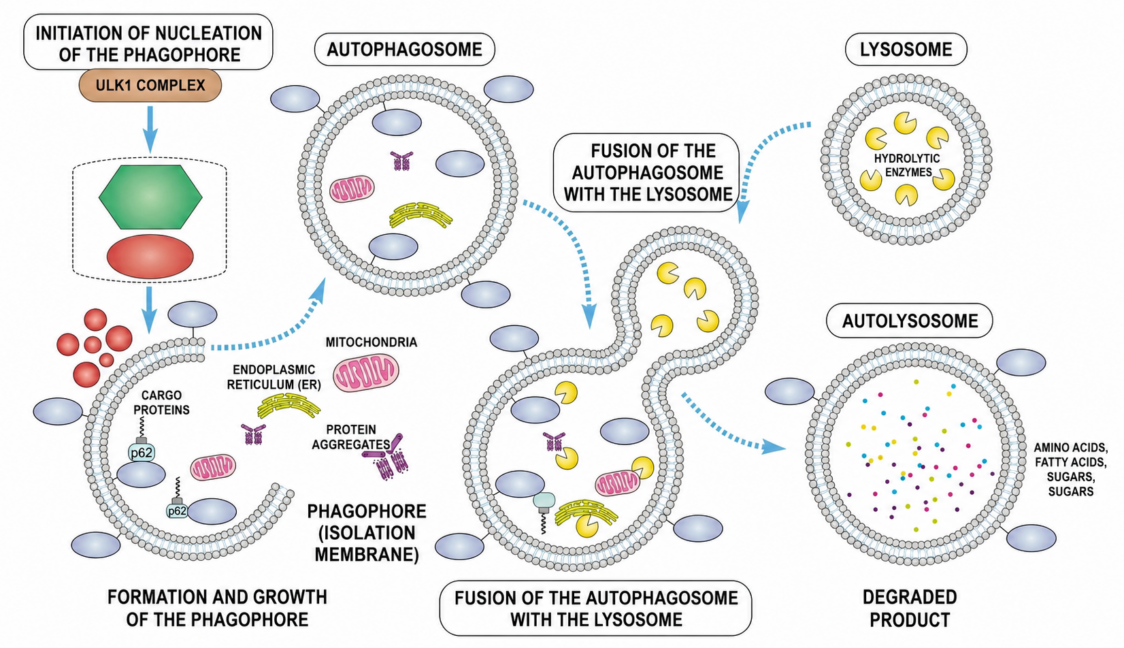
Autophagy proceeds through five key steps: initiation, nucleation (formation of the phagophore), elongation (membrane growth), fusion with a lysosome, and degradation with recycling. We will describe each of these steps in more detail, based on research from scientists at the University of Texas.
1. Initiation: What triggers autophagy?
Autophagy is triggered when a cell detects stress. This can be due to factors such as nutrient deficiencies, low energy levels, organelle damage, or infection. Two protein complexes with opposing effects play a key role in this process. [7,28]
- mTORC1 (mechanistic target of rapamycin complex 1) is a major protein complex that suppresses (inhibits) autophagy. It becomes activated when the cell has sufficient nutrients and energy. [7]
- AMPK (AMP-activated protein kinase), on the other hand, activates autophagy and simultaneously inhibits mTORC1 when the cell is experiencing an energy deficit. [28]
2. Nucleation: The Formation of Phage-Binding Sites
Upon deactivation of mTORC1, the ULK1 protein kinase is activated, initiating the formation of structures called autophagosomes. These are small, cup-shaped membranes that serve as the precursors to the “waste disposal” system. [7]
3. Elongation: The phagophore grows and engulfs the cargo.
The phagophore gradually expands, engulfing cellular waste within the cell. This waste can include worn-out proteins, dysfunctional mitochondria, and other damaged structures. This entire process is regulated by specialised proteins encoded in ATG genes. [6]
4. Completion: The Formation of an Autophagosome
When a phagophore completely surrounds the cargo and closes, an autophagosome is formed. This is a double-membraned vesicle (a transport sac) containing cellular waste, which safely separates damaged material destined for recycling from the rest of the cell. [7]
5. Degradation: Fusion with Lysosomes
The autophagosome then fuses with a lysosome, an organelle that contains powerful digestive enzymes (hydrolases). This creates an autolysosome, within which the contents of the autophagosome are completely broken down. The resulting amino acids, fatty acids, and sugars released from this breakdown are then returned to the cytoplasm, where the cell can reuse them as building blocks or an energy source. [7]
Autophagy is essentially an internal recycling system. Through this process, cells break down damaged or unnecessary components and then reassemble them into something new and functional.
An Overview of the Stages of Autophagy
| Phase of Autophagy | What Happens During This Phase |
|---|---|
| Initiation | mTORC1 is deactivated, AMPK and ULK1 are activated, initiating autophagy. |
| Nucleation | A phagophore forms. |
| Elongation | The phagophore engulfs damaged material. |
| Closure | An autophagosome is formed. |
| Degradation | Fusion with lysosomes, breakdown of contents, and recycling. |
What types of autophagy exist?
Three main types of autophagy function in the human body: macroautophagy, microautophagy, and chaperone-mediated autophagy (CMA).
Each of them performs a slightly different role and utilises different mechanisms to transport cellular waste into the lysosome. Additionally, we know about mitophagy, which is particularly interesting for athletes and people interested in longevity.
1. Macroautophagy
Macroautophagy is the most prevalent and well-studied type of autophagy, where the cell engulfs damaged or unnecessary components within an autophagosome (a specialised vesicle) and sends them to the lysosome for degradation and recycling. This is the process we typically refer to when autophagy is discussed in the context of fasting, exercise, or longevity. [31]
Macroautophagy can process large structures, including entire organelles, which other forms of autophagy cannot. This is precisely why it underlies most of the health benefits associated with autophagy.
2. Microautophagy
Microautophagy is a distinct form of autophagy where lysosomes degrade cellular material in a fundamentally different way compared to macroautophagy – instead of forming a vesicle, it directly engulfs small portions of the cytoplasm through its own membrane. Think of the lysosome as a sort of cleaner that, instead of collecting waste into a bag, simply engulfs all the debris around it. [31]
3. CMA
Chaperone-mediated autophagy (CMA) is the most selective type of autophagy, where the cell degrades only specific, damaged proteins, rather than entire organelles. CMA is primarily activated when the cell is under prolonged stress or has been damaged by oxidative processes. [27]
4. Mitophagy
Mitophagy is a specialised subtype of macroautophagy that specifically targets damaged or worn-out mitochondria (the energy powerhouses of your cells). When mitochondria cease to function properly, specific proteins mark them for degradation, and they are then transported to the lysosome. [29]
Why should anyone be interested in mythophagy?
- Athletes and active individuals, as healthier mitochondria lead to improved energy metabolism, greater endurance, and faster recovery. [29]
- Those interested in healthy ageing and longevity as mitophagy declines with age, and damaged mitochondria accumulate, which impairs cellular function in both the heart and brain. [17]
The good news, however, is that we can support mitophagy, which can influence athletic performance and promote healthier ageing.
How to initiate autophagy?
According to a study published in the journal Frontiers in Physiology, autophagy can be triggered by any condition in which cells sense a lack of energy or nutrients. And there are several ways you can intentionally induce this state.
1. Intermittent Fasting
Intermittent fasting (IF) triggers autophagy by lowering insulin levels, activating the AMPK energy sensor, and blocking mTOR – a key inhibitor of autophagy. This mechanism is well-documented, but primarily supported by studies in animals, rather than in humans. [10]
Studying autophagy in humans is more complex, as measuring it in people is very challenging. One of the largest studies from 2025, published in the respected journal The Journal of Physiology, suggests that intermittent fasting may increase autophagy, but the authors themselves describe the results as preliminary. [2,24]
In practice, this means that intermittent fasting is one of the most promising ways to support autophagy. However, there’s no established recommendation on which intermittent fasting protocol to follow. The claim that autophagy is triggered after 16 hours hasn’t been scientifically proven. If you’re considering intermittent fasting, a practical starting point is the 16:8 protocol (16 hours of fasting and an 8-hour eating window), or a gentler 5:2 approach (5 days of normal eating and 2 days with calorie restriction).
Intermittent Fasting Diet (IFD): An Alternative to Fasting
An interesting alternative to strict fasting is the “Fasting Mimicking Diet” (FMD), developed by Professor Valter Longo at the University of Southern California. It’s a five-day plant-based protocol with low calories and protein, which triggers similar biochemical changes in the body as fasting – a decrease in insulin and IGF-1 and activation of AMPK. These are the changes through which fasting initiates autophagy, suggesting that the FMD could have a similar effect. However, direct evidence of autophagy activation in humans during the FMD is currently lacking. [3,30]

2. Exercise
Exercise activates autophagy through the same mechanism as fasting – it depletes available energy reserves and activates AMPK. When muscles work intensely, energy consumption rapidly increases, and cells respond by initiating a recycling process. Exercise’s support of autophagy is, unlike fasting, also confirmed by research on humans, for example, a study conducted by Belgian scientists in 2015. [11,15,26]
What do the studies show?
- High-intensity exercise promotes autophagy in skeletal muscles. Low-intensity exercise does not have the same effect. Autophagy is best triggered by HIIT (High-Intensity Interval Training), circuit training, sprints, and other intense forms of exercise. [26]
- Endurance training supports both autophagy and mitophagy. Studies show this occurs within the first two hours after exercise, and long-term training increases the overall capacity of cells for autophagy. [4]
- Strength training appears to have a different effect, according to available human studies. Some indicators of autophagy temporarily decrease after strength training, meaning that cells recycle less immediately after the workout. However, this is likely a temporary phenomenon. The long-term impact of strength training on autophagy in humans has not yet been sufficiently studied. [11]
Based on the available evidence, it appears that regular, moderate to high-intensity aerobic exercise is most effective in supporting autophagy. Examples include running, cycling, or high-intensity interval training (HIIT). However, don’t neglect strength training either, as it offers numerous health benefits.
3. Sleep
Sleep supports autophagy through two mechanisms – as a natural nightly fast, which lowers insulin levels and activates AMPK, and via the glymphatic system, which removes toxic proteins (associated, for example, with Alzheimer’s disease) from the brain during deep non-REM sleep. It’s arguably the most underestimated trigger of all, and yet it costs absolutely nothing.
The glymphatic system is essentially the brain’s “waste disposal system,” which, during deep non-REM sleep, removes waste products from the brain, including toxic proteins associated with Alzheimer’s disease. A study published in the journal Brain revealed that even a single night of sleep deprivation significantly reduces this cleansing process. [8,23]
While there’s currently a lack of compelling evidence for autophagy in humans, animal studies consistently show that sleep deprivation disrupts autophagy, whereas good-quality sleep supports it. [22]
The commonly recommended 7–9 hours of quality sleep isn’t just about rest; it’s also a time when the brain performs its regular, extensive cleaning process. Furthermore, it involves several hours of a natural nightly fast, which can, in itself, support autophagy.
If you’re struggling with sleep problems, you might consider supporting your sleep with appropriate supplements. You can find more tips for better sleep in the article How to Fall Asleep Quickly? Try these simple tips for better sleep.
4. Heat Stress
Heat stress activates heat shock proteins (HSP70, HSP90), which work together with autophagy pathways to identify and remove damaged proteins. This mechanism has been confirmed by a review article published in the Journal of Applied Physiology. Most of the data, however, comes from laboratory experiments, rather than direct measurements taken on people in a sauna. [19]
Of all the factors that trigger autophagy, sauna use is the least studied. This doesn’t mean it doesn’t work; it simply means that science is still searching for definitive answers.

| Trigger | Mechanism | Strength of Evidence in Humans | Practical Implementation |
|---|---|---|---|
| Intermittent Fasting | Insulin reduction, AMPK activation, mTOR inhibition | Moderate | 12–14 hours of overnight fasting |
| Aerobic Exercise | ATP depletion, AMPK activation | Strong | 30–60 minutes of moderate intensity |
| Sleep | Overnight fasting + glymphatic clearance | Moderate | 7–9 hours, earlier dinner |
| Heat Stress (Sauna) | HSP70/HSP90 activation | Weak | 15–20 minutes, 80–100 °C* |
*For heat stress, direct measurements of autophagy in humans in saunas are currently lacking – the recommendation is based on preclinical data.
What are the health benefits of autophagy, and what does science say?
Autophagy isn’t just a cleaning service; it’s a fundamental mechanism that helps your cells stay healthy, functional, and resilient. When it functions correctly, it protects you from the buildup of cellular waste, which is behind many age-related diseases. Here are the areas where research speaks most clearly.
1. Longevity: Does slowing autophagy slow down ageing?
Autophagy helps slow down ageing by removing damaged proteins and dysfunctional organelles that accumulate in cells as we age. As we get older, autophagy naturally declines, which is one of the key hallmarks of biological ageing. Supporting autophagy may therefore contribute to slower ageing, and these approaches align perfectly with the principle of longevity. [20]
If you’re interested in how biohackers approach longevity, read our article Is it possible to stop ageing, and how can we effectively manage our biological age today? Science or modern medicine?
2. The Brain: Can Autophagy Protect Against Alzheimer’s and Parkinson’s Diseases?
Autophagy helps protect the brain by removing toxic proteins (such as tau, alpha-synuclein, and others) before they accumulate and damage neurons. A review article published in the journal Neuron in 2025 documents that disruptions in autophagy may contribute to the development of Alzheimer’s and Parkinson’s diseases. Furthermore, genetic studies in humans show that mutations in autophagy-related genes increase the risk of these conditions. [13,32]
Creatine can also be beneficial for the brain, as you’ll read in the article Creatine as Fuel for the Brain: Improves Memory, Focus, and Other Cognitive Functions.

3. The Immune System: Does autophagy strengthen the body’s defences?
Autophagy is a component of the innate immune system and helps cells eliminate bacteria, viruses, and other pathogens directly within the cell. A 2021 review in the journal Immunity details how autophagy regulates the inflammatory response, preventing its excessive activation and enhancing the ability of immune cells to recognise foreign antigens. [5]
You can find more ways to support your immune system in the following articles:
- 15 ways to boost your immune system and protect your health.
- Top supplements for immunity: stronger defences and a faster return to action.
4. Oncological Diseases: Does autophagy have a protective effect against cancer?
In healthy cells, autophagy removes damaged components – including damaged DNA and dysfunctional mitochondria – thereby reducing the likelihood of tumour-causing mutations. However, once cancer develops, cancer cells may utilise autophagy for their own benefit.[33]
That’s precisely why scientists are studying autophagy from two perspectives simultaneously – how to enhance it to prevent cancer, and how to block it to aid in treatment. While definitive clinical recommendations don’t yet exist, it’s one of the most actively researched areas in oncology. [33]
What does this mean for you? Maintaining healthy autophagy through exercise, quality sleep, and a balanced diet is worthwhile as part of preventative care – not as a treatment or replacement for oncological care.

5. Metabolism and Weight Loss: Lipophagy and Fat Stores
Autophagy regulates fat metabolism through a process called lipophagy—the targeted breakdown of fat droplets within the cell. In individuals with obesity, this process is impaired in fat tissue, suggesting its role in metabolic disorders, including type 2 diabetes, and that autophagy may also play a role in weight loss. [25]
A 2024 review of studies reveals that autophagy—a cellular process—is impaired in fat tissue in individuals with obesity, likely as a response to chronic inflammation. [12]
Maintaining functional autophagy through exercise, quality sleep, and proper nutrition may be one of the mechanisms by which a healthy lifestyle protects against metabolic diseases.
You can find more information on how to lose weight more easily in our other articles:
- 10 tips to make losing weight easier and get in shape.
- How to lose weight quickly, even without counting calories.
Overview of the Health Benefits of Autophagy
| Area of Health | Mechanism | Strength of Evidence in Humans |
|---|---|---|
| Aging | Removal of damaged cells, slowing down cellular aging. | Moderate |
| Brain and Neurodegeneration | Removal of toxic proteins (tau, alpha-synuclein). | Strong |
| Immunity | Elimination of pathogens, regulation of the inflammatory response. | Strong |
| Metabolism and Obesity | Regulation of fat metabolism, lipophagy, and insulin sensitivity. | Moderate |
| Cancer | Removal of damaged DNA and dysfunctional organelles. | Weak |
| Weight Loss | Lipophagy – breakdown of fat stores within cells. | Weak |
How is autophagy related to athletic performance and recovery?
1. Does autophagy help with muscle recovery after exercise?
Autophagy is a key mechanism by which muscle tissue removes damaged proteins, oxidised lipids, and worn-out organelles after exercise. Human studies using muscle tissue biopsies confirm that markers of autophagy increase within two hours after exercise. [4]
Without sufficient autophagy, damaged structures can accumulate, which may slow down regeneration and increase oxidative stress. Therefore, supporting autophagy is beneficial for improving regeneration and performance.
Our article 10 tips for the best way to recover your body after a workout will tell you how to support regeneration.
2. Does mitophagy improve athletic performance?
Mitophagy, the process by which damaged mitochondria are gradually removed, can lead to improved quality, more efficient metabolism, and ultimately, better performance. However, it’s also important to note the reverse: exercise itself is one of the most powerful triggers of mitophagy. This creates a closed loop: exercise initiates mitophagy, and mitophagy, in turn, improves the quality of mitochondria, thereby enhancing athletic performance.
For this process to work, you need regular aerobic exercise to initiate it, and sufficient sleep and recovery to allow for adequate mitochondrial repair. [4,11]

3. Does autophagy promote muscle loss?
No, autophagy and muscle catabolism are two fundamentally different processes. Autophagy primarily targets damaged and non-functional proteins, not healthy muscle fibres. Muscle catabolism occurs with prolonged periods of inadequate calorie intake, especially when protein intake is insufficient, and without exercise. Strength training and adequate protein intake are key factors in determining whether fasting will compromise muscle mass or not.
You can find information on how to build and maintain muscle in our article What to eat and how to exercise to finally build muscle?
What to eat and supplement to support autophagy?
The most natural and best-studied triggers of autophagy remain fasting and exercise. However, there are also specific substances, some found in common foods and others in the form of supplements, that research suggests may promote autophagy.
1. Spermidine
Spermidine is a naturally occurring compound found in common foods, and it’s one of the most well-researched dietary activators of autophagy. A study by Hofer et al., published in Nature Cell Biology (2024), demonstrated that fasting increases spermidine levels within cells, and this increase is essential for triggering autophagy – a mechanism that has been confirmed in 4 independent clinical studies on humans. [9]
The best dietary sources of spermidine:
- wheat sprouts
- fermented cheeses
- mushrooms
- soybeans
2. Urolithin A
While spermidine supports overall autophagy, Urolithin A helps activate mitophagy (targeted cleaning of mitochondria). It’s produced in the gut when our gut bacteria break down polyphenols found in pomegranates, berries, or walnuts. Since many people don’t have the right gut bacteria (microbiome) to produce it, biohackers are now widely using it in supplement form to improve muscle endurance and cellular energy. [18,35]
3. Polyphenols
Polyphenols are plant compounds, including EGCG from green tea, curcumin, and resveratrol, which activate autophagy pathways through AMPK and SIRT1. The mechanism is well-documented in laboratory settings, but direct clinical evidence in humans is currently limited. [1]
4. NMN and NR (NAD+ Precursors)
NMN (nicotinamide mononucleotide) and NR (nicotinamide riboside) are precursors to NAD+, a molecule crucial for cellular energy metabolism and the activation of enzymes that support autophagy. Increasing NAD+ levels has been shown in humans after their administration, but the direct impact on autophagy remains a hypothesis. [11]
5. Proteins
Protein intake influences autophagy through mTOR. A high intake of amino acids, particularly leucine, activates this protein complex and temporarily inhibits autophagy. However, this doesn’t mean that proteins are the enemy of autophagy; it’s all about timing.
In practice, this means it’s important to consume enough protein, but if you’re fasting, don’t interfere with its function by consuming protein.
| Substance | Mechanism | Strength of Evidence in Humans | Recommended Source |
|---|---|---|---|
| Spermidine | Direct mediator of autophagy | Strong | Wheat germ, dietary supplement |
| Urolithin A | Direct activator of mitophagy | Moderate | Pomegranates, dietary supplement |
| NMN/ NR | NAD+ → sirtuins → indirect support for autophagy | Moderate | Dietary supplement |
| EGCG | Activation of AMPK | Weak | Green tea |
| Curcumin | Activation of AMPK/SIRT1 | Weak | Dietary supplement |
| Resveratrol | Activation of SIRT1 | Weak | Dietary supplement |
Why is it difficult to measure autophagy in humans?
Autophagy occurs deep within cells, and currently, there’s no simple blood test or device that can tell you how much autophagy is taking place in your body. Scientists can only track its activity indirectly – for example, by measuring specific proteins in the blood – but these markers don’t provide a complete picture of what’s happening in tissues like the brain or muscles. More precise measurements require a tissue biopsy and laboratory analysis, which are not commonly available outside of a research setting. [21,24]
That’s precisely why most claims about when and how autophagy “begins” are based on animal studies or indirect indicators in humans – not on direct measurements. This methodological gap is one of the main reasons why the science of autophagy in humans still lags behind what we know from laboratory models.
How to Improve Autophagy? 5 Steps to Support Autophagy
1. Extend Your Overnight Fasting Window
This is the simplest and most accessible way to get started. Shift your dinner closer to 6:00 – 7:00 PM and eat breakfast later, ideally at least 12 hours after dinner. Without changing what you eat, extending your overnight fast to 12-14 hours will allow insulin levels to decrease, activate AMPK, and encourage your cells to enter a recycling mode. You don’t have to jump straight into a more intense 16-hour fast; start slowly.
2. Move Regularly, Especially with Aerobic Exercise
Exercise activates autophagy through the same mechanism as fasting, by decreasing ATP levels and activating AMPK. Human studies confirm that markers of autophagy increase in the first few hours after exercise, and regular training increases the overall autophagy capacity of muscles. Endurance training is more effective than strength training when it comes to autophagy and mitophagy. However, both types of exercise have a place in your training routine.
How can I move?
- Cycling or swimming for 30–60 minutes, at least 3 times a week.
- High-intensity interval training (HIIT) – short bursts of high intensity followed by periods of rest. To start, you could try an 8-minute Tabata workout, and gradually progress to 20 minutes of HIIT training.
- Strength training to maintain muscle mass (ideally, at least 2 full-body workouts per week).
3. Get Enough Sleep
Sleep is when the brain actively removes toxins, including beta-amyloid, through the glymphatic system. Furthermore, while you sleep, you also undergo a natural, several-hour fast. Aim for 7–9 hours of sleep each night, and also prioritise sleep quality.
4. Incorporate Spermidine-Rich Foods
Of all dietary strategies, spermidine has the strongest scientific backing. Wheatgrass, fermented cheeses, mushrooms, and soybeans are among its best sources. You can also take spermidine in supplement form.
5. Time Your Protein Intake Correctly
Don’t restrict your protein intake, but consume it within your eating window, not during fasting periods. A high intake of amino acids activates mTOR, which temporarily blocks autophagy. Consuming protein after your workout, however, directly targets muscle recovery at a time when autophagy from the previous exercise is already subsiding. Exercise and protein work together to protect muscle mass.
When is supporting autophagy not appropriate?
Intermittent fasting and strategies to promote autophagy are generally safe for most healthy adults. However, there are certain groups for whom these practices are not suitable or require increased caution and consultation with a doctor.
- Pregnancy and Breastfeeding – a calorie deficit can jeopardise fetal development and milk production.
- Type 1 Diabetes – fasting carries a risk of hypoglycemia; adjustments to insulin dosages are necessary under medical supervision.
- Eating Disorders (e.g., anorexia, bulimia) – fasting can worsen the underlying condition.
- Active Tumours – autophagy plays a dual role in tumour cells; consult with an oncologist before making any dietary changes.
If you belong to any of these groups, please consult your doctor before making any changes to your diet.
FAQ: Frequently Asked Questions
The exact time after fasting when autophagy begins is not known. The claim that autophagy starts precisely after 16 hours is not supported by human studies. Autophagy is a process that occurs continuously within cells and gradually intensifies when nutrients are scarce. Think of autophagy not as a simple on/off switch, but rather as a dimmer. It’s never completely turned off; it’s always running at a certain ‘idle’ level. When you start fasting or exercising, this dimmer simply increases in intensity over time.
The best time to fast is during the night and early morning hours, meaning extending your overnight fast rather than fasting during the day. Autophagy is linked to your body’s internal biological clock, and cells recycle more efficiently during the overnight fast.
Black coffee, without milk or sugar, likely won’t interrupt autophagy, and some studies suggest it might even slightly enhance it. However, any intake of calories, particularly proteins and carbohydrates, activates mTOR, which can temporarily slow down autophagy.
No, you won’t lose muscle mass due to autophagy, as long as you follow basic guidelines. Autophagy targets damaged and dysfunctional proteins, not healthy muscle fibers. Muscle loss occurs with prolonged fasting without sufficient protein intake and without exercise, not during intermittent fasting combined with strength training.
No, autophagy doesn’t directly lead to weight loss. While autophagy can break down fat stores within cells through a process called lipophagy, there’s currently a lack of direct clinical evidence showing that increasing autophagy results in a measurable reduction in weight in humans. Weight loss associated with intermittent fasting is a result of a calorie deficit, not autophagy itself.
Ketosis activates the same pathways as fasting (reducing insulin and activating AMPK), and therefore may contribute to the initiation of autophagy. However, direct measurements of autophagy in humans following a ketogenic diet are currently limited, and most of the evidence comes from animal studies.
In everyday practice, no. Measuring autophagy in humans is scientifically very challenging, and currently, it’s not available outside of research laboratories. No readily available blood test or home test can reliably tell you whether your cells are undergoing this process.
No, autophagy is a specific cellular process with a clearly defined mechanism and is the subject of serious scientific research. The term “detox” in the context of diets and supplements lacks a real physiological basis.
Yes, autophagy can be partially supported through dietary supplements, particularly with spermidine. Its effect on autophagy has been confirmed in clinical studies involving humans. While polyphenols like EGCG, curcumin, or resveratrol have proposed mechanisms of action, direct evidence in humans is limited.
No, autophagy is neither a detox nor a treatment. It’s a natural cellular process that occurs constantly in the body and helps maintain cell health by removing damaged components. The term “detox” in the context of supplements and wellness products generally lacks a scientifically defined meaning and is not related to autophagy.
Probably not, especially if consumed without calories. Artificial sweeteners don’t contain protein or carbohydrates, and therefore they don’t directly activate mTOR or raise insulin levels – which are the primary mechanisms by which food inhibits autophagy. Direct measurements of the impact of sweeteners on autophagy in humans are currently lacking.
Neither water with lemon nor apple cider vinegar will stop autophagy, as both contain only negligible amounts of calories and, according to current evidence, do not activate mTOR or significantly raise insulin levels to the point of halting autophagy. Direct evidence regarding the effects of these beverages on autophagy in humans, however, is lacking.
It’s not currently known; it hasn’t been directly measured in humans. Animal studies suggest an increase in autophagy after 24 hours, with a peak around 48 hours of fasting. In humans, it depends on individual metabolism, glycogen stores, and other factors. There’s no precise timeline for humans.
No, intentionally fasting to promote autophagy is not recommended during pregnancy or breastfeeding. A lack of nutrients can negatively impact fetal development and the quality of breast milk. Consult with a doctor before making any dietary changes during this time.
What does this mean for you?
Autophagy is a real and well-studied biological process, not just a passing trend. Your cells perform it every day, and when it functions correctly, it protects you from the buildup of cellular waste, which is linked to many of the diseases associated with ageing.
- Intermittent fasting (overnight) – extend it by having an earlier dinner and a later breakfast.
- Exercise – particularly endurance training at moderate to high intensity.
- Quality sleep – 7 to 9 hours, during which the brain actively cleanses itself.
- A diet rich in spermidine, or consider supplementation.
At the same time, be sceptical of claims that autophagy is triggered exactly 16 hours after starting, that a specific supplement will initiate it, or that it’s a miraculous weight loss tool. Science is still searching for answers in this area.
[1] AHMED, M. Targeting aging pathways with natural compounds: a review of curcumin, epigallocatechin gallate, thymoquinone, and resveratrol. – https://pmc.ncbi.nlm.nih.gov/articles/PMC12225039/
[2] BENSALEM, J., et al. Intermittent time-restricted eating may enhance autophagy in humans: an exploratory analysis. – https://onlinelibrary.wiley.com/doi/abs/10.1113/JP287938
[3] BRANDHORST, S., et al. A fasting-mimicking diet leads to changes in liver and blood markers, suggesting a reduction in biological age and a lower risk of disease. – https://www.nature.com/articles/s41467-024-45260-9
[4] BRANDT, N. et al. Exercise and exercise training increase autophagy markers in human skeletal muscle. – https://pubmed.ncbi.nlm.nih.gov/29626392/
[5] DERETIC, V. The role of autophagy in inflammation, infection, and immunometabolism. – https://pmc.ncbi.nlm.nih.gov/articles/PMC8026106/
[6] DIKIC, I. - ELAZAR, Z. The mechanisms and medical implications of autophagy in mammals. – https://www.nature.com/articles/s41580-018-0003-4
[7] DOSSOU, A.S. - BASU, A. The Expanding Role of mTORC1 in Regulating Autophagy. – https://pmc.ncbi.nlm.nih.gov/articles/PMC6826502/
[8] EIDE, P.K. et al. Sleep deprivation disrupts the brain's natural process of cellular waste removal. – https://pubmed.ncbi.nlm.nih.gov/33829232/
[9] HOFER, S.J. et al. Spermidine is crucial for autophagy induced by fasting and for promoting longevity. CHAUDHARY, R. et al. Intermittent fasting triggers autophagy markers in mouse liver tissue, but not in muscle tissue from either mice or humans. – https://pubmed.ncbi.nlm.nih.gov/35660501/
[10] CHEN, F. et al. The impact of nicotinamide mononucleotide on glucose and lipid metabolism in adults: a systematic review and meta-analysis of randomized controlled trials. – https://pubmed.ncbi.nlm.nih.gov/39531138/
[11] JAKUBEK, P. et al. Autophagy changes in obesity, type 2 diabetes, and metabolic dysfunction-associated steatotic liver disease: evidence from human studies. – https://pubmed.ncbi.nlm.nih.gov/38971910/
[12] KARABIYIK, C. et al. Autophagy in aging and age-related neurodegenerative diseases. – https://www.oaepublish.com/articles/and.2021.05
[13] KE, P.-Y. Cellular self-digestion: Autophagy and the 2016 Nobel Prize in Physiology or Medicine. – https://pmc.ncbi.nlm.nih.gov/articles/PMC6138592/
[14] LAKER, R.C. AMPK-mediated phosphorylation of Ulk1 is essential for the delivery of mitochondria to lysosomes during exercise-induced mitophagy. – https://pmc.ncbi.nlm.nih.gov/articles/PMC5601463/
[15] LEVINE, B. - KLIONSKY, D.J. Autophagy is recognized with the 2016 Nobel Prize in Physiology or Medicine: Discoveries in baker's yeast have driven significant progress in biomedical research. – https://pubmed.ncbi.nlm.nih.gov/28039434/
[16] LI, J. et al. PINK1/Parkin-mediated mitophagy in neurodegenerative diseases. LIU, S. et al. The impact of Urolithin A supplementation on muscle endurance and mitochondrial health in older adults.
[17] MCCORMICK, J.J. et al. Autophagy and heat: exploring the potential of heat therapy to enhance autophagy in both healthy individuals and those with disease.
[18] MICELI, C. et al. Autophagy-related proteins: Potential diagnostic and prognostic biomarkers for age-related diseases. – https://www.sciencedirect.com/science/article/pii/S1568163723001265
[19] MIZUSHIMA, N. - MURPHY, L.O. Autophagy Assays for Biological Discovery and Therapeutic Development. – https://pubmed.ncbi.nlm.nih.gov/32839099/
[20] RUBINSZTEIN, D.C. - FRAKE, R.A. Yoshinori Ohsumi's Nobel Prize: Recognizing the mechanisms of autophagy, from fundamental yeast biology to therapeutic possibilities. SANGALLI, L. - BOGGERO, I.A. The effects of sleep components, quality, and patterns on the glymphatic system in healthy adults: A systematic review.
[21] SARGEANT, T.J. - BENSALEM, J. Measuring autophagy in humans: a significant obstacle to progress.
[22] SHIN, D.W. Lipophagy: Molecular mechanisms and its role in metabolic disorders. SCHWALM, C. et al. Autophagy in human skeletal muscle is influenced by exercise intensity and activation of AMPK.
[23] TEKIRDAG, K. - CUERVO, A.M. Chaperone-mediated autophagy and endosomal microautophagy: A shared mechanism.
[24] WANG, S. et al. The role of AMPK in autophagy. The mitophagy pathway and its role in human diseases. – https://pmc.ncbi.nlm.nih.gov/articles/PMC10427715/
[25] WEI, M. et al. The effects of a fasting-mimicking diet on markers and risk factors associated with aging, diabetes, cancer, and cardiovascular disease. – https://pmc.ncbi.nlm.nih.gov/articles/PMC6816332/
[26] YAMAMOTO, H. and MATSUI, T. Molecular mechanisms of macroautophagy, microautophagy, and chaperone-mediated autophagy. Autophagy, aging, and age-related neurodegeneration: *Neuron*.
[27] Autophagy: A link between aging, cellular senescence, and cancer.
[28] Nobel Prize in Physiology or Medicine, 2016. Urolithins: A Comprehensive Update on Their Metabolism, Bioactivity, and the Gut Microbiota Involved.
Add a comment