
Table of Contents
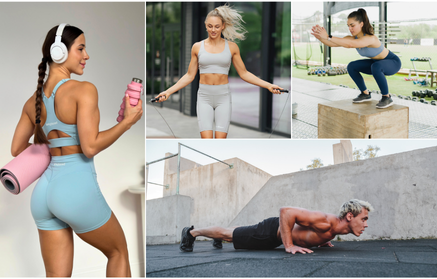
How can you get the most out of just 20 minutes of training? The answer is HIIT, which combines short bursts of high-intensity exercise with rest periods. This lets you burn a significant number of calories in a short time while working the entire body. Whether your goal is weight loss or improving fitness, HIIT is the perfect choice. Let’s take a look at the benefits of cardio HIIT, suitable exercises, and how to structure a workout.
What Is HIIT?
HIIT is a form of high-intensity interval training that alternates between short, intense bouts of exercise and brief rest periods. During one interval, you push yourself to the limit, and in the next, you rest or do a lighter activity. These cycles of intense exercise and rest/light activity repeat until the session is complete.
- Interval duration: Typically 10–60 seconds of exercise, with rest periods lasting 10–60 seconds.
- Workout difficulty: Beginners usually match work and rest intervals (e.g., 30 seconds on, 30 seconds off). In some cases, rest may be longer. As fitness improves, rest time is shortened and work intervals extended.
- Variability: Advanced athletes might perform 60-second work intervals with only 15 seconds of rest. Instead of resting, they might switch to a lower-intensity version of the exercise (e.g., replacing jump squats with regular squats).
- Number of cycles (work/rest intervals): Depends on the number of exercises. Classic HIIT sessions typically involve 3–6 cycles. Tabata training, a subtype of HIIT, consists of 8 cycles.
- Number of rounds: Usually 2–5, depending on fitness level and desired workout length.
How to Track Time During HIIT?
To monitor your work and rest intervals, you can use a mobile app or workout timer. These tools often have a HIIT mode, allowing you to easily set your intervals to suit your needs. That way, you can fully focus on your training.
- You can learn more about HIIT in the article Traditional Cardio or HIIT Training – Which Burns More Fat?
- Tabata, another type of HIIT training, is covered in Tabata: A Full-Body Workout That Only Takes 12 Minutes.

Why Try HIIT Cardio? 5 Key Benefits
Not everyone has the time for traditional cardio, like running, cycling, or rowing for 30 minutes or more. While steady-state aerobic training at low to moderate intensity has many health benefits, it’s not for everyone. Luckily, HIIT offers similar benefits in a shorter amount of time. It adds variety to your training and fits into even the busiest schedules. Ideally, you should include both forms of cardio in your routine to get the best of both worlds.
1. Burn Calories More Effectively and Boost Fat Loss
HIIT is well known for its calorie-burning effects, not just during the workout but also afterwards. This phenomenon is called EPOC (Excess Post-exercise Oxygen Consumption), which leads to increased energy expenditure even at rest. Commonly referred to as a “boosted metabolism,” this means your body continues to burn calories for hours after the workout, which can significantly aid weight loss . [1–3]
If fat loss is your main goal and you want to learn how to achieve it, you’ll find everything you need in the article The Simple Basics of Weight Loss: You Might Be Surprised What Really Matters.

2. Improve Your Fitness
By regularly including HIIT in your training routine, you can significantly boost your cardiovascular fitness (VO2 max)—your heart, lungs, and blood vessels’ ability to deliver oxygen to your muscles during exercise. The intense intervals raise your heart rate substantially, which activates the body’s adaptive mechanisms and results in more efficient organ function. With better fitness, you’ll not only improve your workouts but also find everyday activities like climbing stairs or running for the bus less taxing. [4]
3. Preserve Muscle Mass While Losing Fat
Endurance training, especially during a high-calorie deficit, can result in the loss of both fat and muscle mass. HIIT, on the other hand, is usually short enough to avoid the body turning to muscle as an energy source. The compound exercises typically found in HIIT sessions activate your muscles more intensely. That way, your body is informed that these muscles are still needed and shouldn’t be broken down. It’s therefore an ideal workout for those aiming to burn fat while preserving as much muscle as possible. [6–7]
If building muscle is your primary goal, don’t miss our article 10 Nutrition Tips for Maximum Muscle Growth.

4. Get a Quality Workout in Less Time
One of HIIT’s biggest advantages is its time efficiency. Short, intense sessions can deliver results comparable to—or in some cases even better than—longer low-intensity cardio sessions. That makes it perfect for anyone with a busy schedule who still wants to improve their fitness, health, and fat-loss results. [5]
5. Tailor the Workout to Suit You
HIIT is flexible and suitable for both beginners and experienced athletes. You can include exercises with or without equipment and adjust the difficulty to suit your level. Plus, it’s not limited to typical bodyweight workouts—you can apply the interval format to running too. For example, a HIIT run might involve sprinting at full speed for 30 seconds, followed by 30 seconds of walking or slower jogging. You can also customise the length of your work and rest intervals to suit your goals. Everyone can build their own personalised fit HIIT workout.
You might be interested in these products:
Cardio HIIT: Sample Workout for a Better Physique and Improved Fitness
Cardio HIIT sessions typically involve compound exercises that engage multiple muscle groups across the body. When choosing the length of your work and rest intervals, opt for a structure that matches your current fitness level—whether you’re a beginner or more advanced. You’ll start with a working interval, take a short rest between exercises, and then move on to the next movement. After completing a full round, take a slightly longer rest before starting the next set.
Before jumping into the workout, make sure to try out each of the exercises beforehand. It’s also important to include at least a brief warm-up to mobilise your joints and get your body ready to move. After you finish the session, don’t forget a short cooldown with some light stretching.
1. Beginner Workout Structure
- Work interval: 30 seconds
- Rest between exercises: 30 seconds
- Rest between sets: 40 seconds
- Number of sets: 4
- Number of intervals: 5
- Total duration: 20 minutes (excluding warm-up and cool-down)
- Calories burned (active phase only): A 65 kg woman burns approximately 125 kcal, while an 80 kg man burns around 167 kcal. [8]
2. Advanced Workout Structure
- Work interval: 40 seconds
- Rest between exercises: 20 seconds
- Rest between sets: 30 seconds
- Number of sets: 4
- Number of intervals: 5
- Total duration: 20 minutes (excluding warm-up and cool-down)
- Calories burned (active phase only): A 65 kg woman burns approximately 154 kcal, while an 80 kg man burns around 205 kcal. [8]

5 Exercises for Your Cardio HIIT Session
For this workout, prepare a skipping rope, a plyo box, and an exercise mat. If you’re training at home, make sure you’ve cleared enough space around you. That said, this session also works well at the gym or at an outdoor workout spot. If you don’t have access to a plyo box, you can use a low wall or a sturdy bench instead.
1. Jumping Jacks
- Starting position: Stand upright with your feet together. Bend your arms slightly at the elbows and keep them by your sides.
- Execution: Jump out to the sides with your feet while simultaneously raising your slightly bent arms overhead. Exhale as you jump out, then inhale as you return to the starting position. Continue the movement fluidly in a steady rhythm.
- Common mistakes: Uncoordinated movement, limited range of motion.
- Variations: You can increase the difficulty by wearing a weighted vest or adding wrist and ankle weights.

2. Skipping (Basic Jump Rope)
- Starting position: Stand with your feet together, gripping the handles of your skipping rope with the rope resting behind you.
- Execution: Begin by rotating your wrists forward to swing the rope. As it passes overhead, bend your knees slightly. When it approaches your feet, jump a few centimetres off the ground. Immediately continue into the next repetition.
- Common mistakes: Poor coordination.
- Variations: If you don’t have a rope handy or space is limited, you can simulate the movement by jumping in place. For home workouts, a cordless skipping rope can also be useful—no tripping over the rope or knocking into furniture.

If you’re keen to try a full HIIT workout just with a skipping rope, check out our article How to Skip Like a Pro: 6 Exercises and 3 HIIT Routines for Maximum Fat Burn.
3. Box Step-Ups With Knee Drive
- Starting position: Stand in front of a plyo box with your feet together. Keep your arms by your sides, slightly bent at the elbows.
- Execution: Lift one foot and place it on the box, shifting your weight onto it. As you exhale, straighten your supporting leg and simultaneously drive the opposite knee upwards towards your chest. As your knee rises, swing the opposite bent arm slightly forward to help with balance. If pulling the knee all the way to your chest feels unstable, simply bend it and raise the foot a few centimetres above the box. Inhale as you return to the starting position, then switch legs for the next repetition.
- Common mistakes: Unstable or uncoordinated movement.
- Variations: Beginners can step up onto the box with both feet without the added knee drive. More advanced athletes can add a single-leg jump at the top of the movement.

4. Box Jumps
- Starting position: Stand in front of the box with your feet together. Keep your arms by your sides and elbows slightly bent.
- Execution: Slightly bend your knees, then exhale as you powerfully jump onto the box with both feet. Use the momentum from swinging your arms forward to assist the jump. Stand up straight, then inhale as you carefully step back down and continue with the next repetition.
- Common mistakes: Poor coordination.
- Variations: Beginners should opt for a lower box, while advanced individuals can flip the box to its tallest side. For an extra challenge, you can stack weight plates on top—but be cautious, as these can shift underfoot.

5. Burpees
- Starting position: Stand with your feet shoulder-width apart and arms relaxed by your sides.
- Execution: Inhale, bend your knees and lower into a squat. Place your hands on the floor in front of you and jump your feet back into a plank position. Bend your elbows and lower your entire body to the mat in a press-up motion. Then, exhale as you push yourself off the floor, straighten your arms, and jump your feet forward towards your hands. Move back into a squat and finish with a powerful jump upwards, raising your arms overhead. Immediately follow with the next repetition.
- Common mistakes: Poor coordination.
- Variations: You can try half burpees, where you skip lying flat on the ground and stop in the plank position instead.

Full-Body HIIT
Try our complete body HIIT workout featured in our training video.
Where to Next?
- Looking for more bodyweight exercises that are perfect for HIIT? Check out 12 Bodyweight Exercises That Will Get Anyone in Shape.
- If you’d like to try a HIIT session focused on abs, don’t miss the two sample workouts in the article Sculpted Abs Training Under 15 Minutes?
- You can also build a killer core routine using moves from The 21 Best Bodyweight Ab Exercises.
- Prefer to add resistance? Create your HIIT circuit using weighted vest exercises from the article 10 Best Full-Body Exercises with a Weighted Vest.
- How about glutes and legs? Include movements from Home Glute and Leg Workout.
- Plank is perfect for HIIT too—get inspired with 24 of the Most Effective Plank Variations.
- You can also mix things up with circuit training. For more ideas, take a look at Core Circuit Training: Your Path to a Six-Pack and a Strong Midsection.
What Should You Remember?
HIIT is a fantastic option for anyone wanting an efficient, high-quality workout in just 20 minutes. Despite the short duration, the high intensity helps you burn loads of calories and kick-start your metabolism. It also boosts your overall fitness and helps preserve muscle mass—especially useful if you’re trying to lose fat. You can follow our sample routine or tailor your own HIIT session with different cardio exercises that suit your preferences.
Did you find this article helpful? If so, share it with your friends and spread the motivation to try a cardio HIIT workout!
[1] Atakan, M. M., Li, Y., Koşar, Ş. N., Turnagöl, H. H., & Yan, X.. Evidence-Based Effects of High-Intensity Interval Training on Exercise Capacity and Health: A Review with Historical Perspective. – https://doi.org/10.3390/ijerph18137201
[2] Soeria Santoso, D. I., & Boenyamin, H. A. The benefits and physiological changes of high intensity interval training.– https://doi.org/10.18051/UnivMed.2019.v38.209-216
[3] Ahlert, M., Matzenbacher, F., Albarello, J. C. dos S., & Halmenschlager, G. H. (2019). COMPARISON OF EPOC AND RECOVERY ENERGY EXPENDITURE BETWEEN HIIT AND CONTINUOUS AEROBIC EXERCISE TRAINING. Revista Brasileira de Medicina Do Esporte.– https://doi.org/10.1590/1517-869220192501181346
[4] Wen, D., Utesch, T., Wu, J., Robertson, S., Liu, J., Hu, G., & Chen, H. Effects of different protocols of high intensity interval training for VO2max improvements in adults: A meta-analysis of randomised controlled trials. – https://doi.org/10.1016/j.jsams.2019.01.013
[5] ScienceDaily.High-intensity interval training is time-efficient and effective, study suggests. – https://www.sciencedaily.com/releases/2010/03/100311123639.htm
[6] Applied Physiology Nutrition and Metabolism. Is low-volume high-intensity interval training a time-efficient strategy to improve cardiometabolic health and body composition?– https://doi.org/10.1139/apnm-2023-0329
[7] Monsalves-Álvarez, M., Jiménez, T., Bunout, D., Barrera, G., Hirsch, S., Sepúlveda-Guzman, C., Silva, C., Rodriguez, J. M., Troncoso, R., & de la Maza, M. P. High-intensity interval training prevents muscle mass loss in overweight Chilean young adults during a hypocaloric-Mediterranean diet: A randomized trial. – https://doi.org/10.3389/fnut.2023.1181436
[8] Compendium of Physical Activities.Conditioning Exercise. – https://pacompendium.com/conditioning-exercise/
Add a comment