

Table of Contents
We live in an era of constant access to both nutritious and less healthy foods. There is so much food available that a significant portion of it ends up in the bin. Hunger is no longer a widespread issue, and if needed, we can quickly obtain the necessary calories. However, a side effect of this era of food abundance is the increasing number of people who are overweight or obese. At the same time, our natural need for physical activity has declined, which further promotes excessive fat storage. The human body is built to store fat reserves, but an excessive amount brings substantial health risks. The fat we once relied on for survival now complicates life, both physically and mentally. So, where does the boundary between health and disease lie when it comes to overweight and obesity?
How Can We Determine a Healthy Body Weight?
1. BMI
One of the most commonly used measurements for determining whether a person has a healthy weight is the Body Mass Index (BMI). BMI evaluates the proportions of height and weight and is widely used to classify weight status.
The BMI calculation is very simple:
- BMI = body weight (kg) / height (m)2
| <18.5 | Underweight | Minimal |
| 18.5 – 24.9 | Normal weight | Minimal |
| 25 – 29.9 | Overweight | Increased |
| 30 – 34.9 | Obesity | High |
| 35 – 39.9 | Severe obesity | Very high |
| >40 | Morbid obesity | Extremely high |
Under normal circumstances, BMI indicates that values above 24.9 fall into the overweight category, where various health risks become more likely. However, BMI does not take into account body composition, meaning it does not differentiate between fat mass and muscle mass. This limitation is particularly evident in specific cases, such as bodybuilders, who may be classified as overweight or even obese despite having very low body fat percentages. Therefore, it is essential to consider these limitations when interpreting BMI. That being said, BMI remains an excellent screening tool for assessing large populations and provides a general overview of weight distribution among different groups. You can calculate your BMI using our online BMI calculator. However, there are even better indicators available.
You might be interested in these products:
2. Waist-to-Hip Ratio (WHR)
One of the simplest measurable indicators of health is the waist-to-hip ratio (WHR). This metric directly reflects the amount of abdominal fat, which is strongly correlated with an increased risk of chronic diseases such as type 2 diabetes and cardiovascular disease.
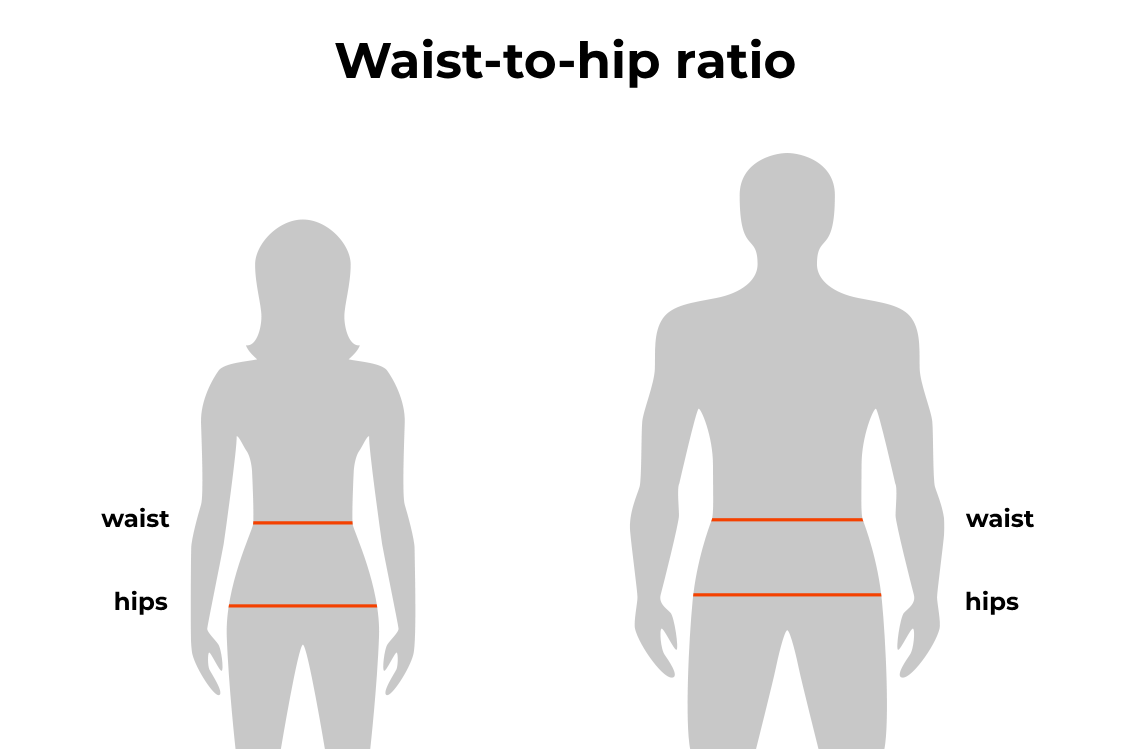
The waist-to-hip ratio is typically more pronounced in women due to natural differences in body structure.
Since excessive fat accumulation in the abdominal area is a major risk factor for obesity-related chronic diseases, WHR is considered a strong indicator of health risk.
| Gender | Men | Women | Men | Women | Men | Women | Men | Women |
| Low risk | <0.83 | <0.71 | <0.84 | <0.72 | <0.88 | <0.73 | <0.90 | <0.74 |
| Moderate risk | 0.83-0.88 | 0.71-0.77 | 0.84-0.91 | 0.72-0.78 | 0.88-0.95 | 0.73-0.79 | 0.90-0.96 | 0.74-0.81 |
| High risk | 0.89-0.94 | 0.78-0.82 | 0.92-0.96 | 0.79-0.84 | 0.96-1.00 | 0.80-0.87 | 0.97-1.02 | 0.82-0.88 |
| Very high risk | >0.94 | >0.82 | >0.96 | >0.84 | >1.00 | >0.87 | >1.02 | >0.88 |
The health risks associated with WHR vary depending on gender and age. [1]
3. Bioimpedance Analysis
Another method for assessing body composition—specifically body fat percentage and muscle mass—is bioimpedance analysis. This technique relies on the fact that different tissues in the human body have varying electrical resistance depending on their composition. By passing a low-level electrical current through the body, bioimpedance devices can measure electrical resistance of individual tissues, which provides an estimate of body composition. However, results can be affected by hydration levels—for instance, if a person is dehydrated, the readings may be inaccurate. There are also differences between smart scales, which measure impedance only through the feet, and more advanced devices, such as InBody, Omron, or Tanita, which use hand and foot electrodes for a more accurate full-body measurement.
Where Is the Line Between a Healthy and Unhealthy Weight?
The boundary between a healthy and unhealthy weight is highly individual. It’s not just about the number on the scale but also body composition, height, gender, and genetics. For example, a bodybuilder weighing 100 kg likely has a lower risk of chronic diseases than a shorter man with the same weight, where the excess mass comes from fat rather than muscle.
The limitations of BMI in assessing body composition can be overcome by using WHR measurements, which help determine whether a person has a healthy weight. The primary risk is the accumulation of abdominal fat, particularly visceral fat. For the average person, BMI remains a useful tool, providing a general indication of whether someone is approaching the threshold of overweight. And overweight can easily lead to obesity.
Being overweight does not necessarily mean a person has chronic diseases, but it does increase health risks. Obesity, however, is objectively an unhealthy condition. It is associated with disruptions in hormonal balance, including sex hormones, leptin, and insulin. Obese men typically have lower testosterone levels and higher estrogen levels. Obese women generally have lower estrogen levels than women with a healthy weight. [2 – 3]

Leptin is a hormone produced by fat tissue that signals satiety to the brain, helping regulate fat stores and appetite. Leptin also plays a role in the yo-yo effect—when a person loses weight rapidly, leptin levels drop, triggering increased hunger and often leading to weight regain. In obesity, this system becomes dysregulated—the brain no longer correctly interprets how much fat is stored in the body. As a result, it constantly signals the need to store more fat, leading to increased hunger and overeating. [4]
Obesity is also a major risk factor for the development of type 2 diabetes , a condition where insulin function fails. Despite the body producing large amounts of insulin, the cells become insulin resistant, meaning they no longer respond effectively to it. As a result, blood glucose levels continue to rise. This issue is closely related to excess fat tissue, which produces pro-inflammatory substances. These compounds contribute to insulin resistance. [5]
The primary driver of cardiovascular diseases in obese individuals is metabolic syndrome. People with metabolic syndrome typically have an apple-shaped (android) or pear-shaped (gynoid) body type, which indicates an excessive accumulation of fat tissue in the abdominal area.
Android obesity is more common in men and is characterised by fat accumulation around the abdomen and upper body. This fat distribution is strongly linked to a higher risk of cardiovascular disease, type 2 diabetes, and metabolic syndrome. Although typically seen in men, android fat distribution can also occur in women.
Gynoid obesity is more common in women and is defined by fat accumulation around the hips, thighs, and buttocks. While this fat distribution is less harmful to health compared to android obesity, maintaining a healthy weight is still recommended. Similarly, gynoid fat distribution can also occur in men.

A person is diagnosed with metabolic syndrome if they exhibit at least three of the following criteria:
- Abdominal obesity – Excess fat around the waist, defined as a waist circumference over ~102 cm in men and ~89 cm in women.
- High blood pressure – 140/90 mmHg or higher.
- Elevated blood glucose levels (glycaemia) – Typically above 100 mg/L fasting (equal to or greater than 5.6 mmol/L).
- High levels of triglycerides (blood fats) – Above 150 mg/L (≥1.7 mmol/L).
- Low levels of “good” HDL cholesterol – Below 40 mg/L in men and below 50 mg/L in women (men <0.9 mmol/L, women <1.1 mmol/L).
Metabolic syndrome itself does not cause obvious symptoms. However, it is strongly associated with hypertension (high blood pressure), dyslipidaemia (low HDL cholesterol, high LDL cholesterol, and high triglycerides), insulin resistance (diabetes) and excess fat tissue accumulation. Being overweight increases the risk of developing metabolic syndrome, and obesity further exacerbates this risk. [6]
A particular concern is so called “skinny fat”—a condition affecting an increasing number of people, many of whom are completely unaware of it. Skinny fat individuals have an excessive amount of fat tissue but very little muscle mass, despite having a normal BMI. Why is this a problem? Muscle mass is crucial not only for movement but also for regulating hormones and immune function. Muscles are the body’s primary energy consumers—a lack of muscle lowers metabolism and increases health risks similarly to obesity.

Why Is There No Such Thing as Healthy Obesity?
In scientific literature, the term “metabolically healthy obesity” is sometimes used. This concept emerged from observations of obese individuals who were not diagnosed with metabolic syndrome—meaning they did not meet at least three out of five diagnostic criteria. This condition is, however, very rare. Even if some individuals do not immediately develop metabolic syndrome, they often show at least two risk factors, the most common being high blood pressure. Furthermore, this state is temporary—as a person ages, the likelihood of developing metabolic syndrome increases. Metabolic health tends to deteriorate in proportion to increasing BMI. [7]
Thus, “metabolically healthy obesity” is not a permanent condition. Over time, it inevitably leads to metabolic syndrome and does not account for other negative health effects, such as chronic inflammation, which contributes to obesity-related cardiovascular diseases and certain types of cancer.
Obesity also significantly raises the risk of developing: [8]
- Heart disease and diabetes
- Various types of cancer
- Joint pain and musculoskeletal disorders
- Liver and kidney diseases
- Sleep apnoea
- Depression

Causes of Obesity
The primary causes of obesity stem directly from modern lifestyle habits. While genetics can play a role, it accounts for only about 5% of all obesity cases. The remaining 95% are primarily the result of diet and lifestyle choices. We have previously discussed the impact of genetics on obesity in this article.
We live in an obesogenic era, where calorie-dense, unhealthy foods are more accessible and affordable than ever. We no longer even need to leave the sofa to get food, and we’re naturally drawn to highly palatable, calorie-rich options. At the same time, our daily movement has drastically declined, making it even easier to consume more energy than we burn. This imbalance directly contributes to the accumulation of excess fat, which the body instinctively stores as a reserve for hard times. However, in today’s world, we rarely need to tap into these energy reserves, leading to gradual weight gain, overweight, and ultimately obesity.
How to Achieve Optimal Body Weight?
Optimal body weight is highly individual. However, the principles of weight management remain the same for everyone. If you are already at a healthy weight, the key is to maintain it. However, for those who need to lose weight, the process can be challenging. It is true that caloric deficit is the only way to lose weight, but sustaining it is difficult. The human brain strongly resists weight loss and actively seeks out high-calorie, sugary foods to maintain its fat stores.
The foundation of any effective weight loss strategy is a balanced diet combined with sufficient physical activity. However, weight loss requires more than just a meal plan and a gym membership—it is the small daily habits that accumulate over time and determine success.
Some key factors that significantly improve weight loss include increasing your daily step count, reducing portion sizes, getting enough sleep, or staying properly hydrated. We have previously discussed why weight loss is difficult and what happens to fat when we lose it in another article.
For those with morbid obesity or weight-related health issues, medical supervision is necessary. In such cases, consulting a doctor, nutritionist, or personal trainer is highly recommended. Even small changes can lead to significant long-term health improvements, allowing individuals to enjoy a longer, healthier life with their families.
Although weight loss can feel like a slow process, and the number on the scale may not change quickly, this does not mean you are not making progress. Sustainable weight loss is a long journey that involves not just fat loss but also muscle gain (particularly if an individual engages in regular exercise).

Conclusion
The boundary between healthy and unhealthy body weight varies for each individual. However, there are objective measurements that can help determine where one stands. Maintaining a healthy weight and body fat percentage is essential for preventing numerous chronic diseases associated with overweight and obesity. Although achieving an optimal weight can be challenging, the long-term health benefits make the effort worthwhile.
[1] Mthombeni S, Coopoo Y, Noorbhai H. Physical Health Status of Emergency Care Providers in South Africa – https://brieflands.com/articles/asjsm-100261
[2] Fui MN, Dupuis P, Grossmann M. Lowered testosterone in male obesity: mechanisms, morbidity and management – https://pubmed.ncbi.nlm.nih.gov/24407187/
[3] Freeman EW, Sammel MD, Lin H, Gracia CR. Obesity and reproductive hormone levels in the transition to menopause – https://pubmed.ncbi.nlm.nih.gov/20216473/
[4] Obradovic M, Sudar-Milovanovic E, Soskic S, Essack M, Arya S, Stewart AJ, Gojobori T, Isenovic ER. Leptin and Obesity: Role and Clinical Implication – https://pubmed.ncbi.nlm.nih.gov/34084149/
[5] Rehman K, Akash MSH, Liaqat A, Kamal S, Qadir MI, Rasul A. Role of Interleukin-6 in Development of Insulin Resistance and Type 2 Diabetes Mellitus. – https://pubmed.ncbi.nlm.nih.gov/29199608/
[6] Neeland, I.J., Lim, S., Tchernof, A. et al. Metabolic syndrome – https://pubmed.ncbi.nlm.nih.gov/39420195/
[7] Marcus Y, Segev E, Shefer G, Eilam D, Shenkerman G, Buch A, Shenhar-Tsarfaty S, Zeltser D, Shapira I, Berliner S, et al. Metabolically Healthy Obesity Is a Misnomer: Components of the Metabolic Syndrome Linearly Increase with BMI as a Function of Age and Gender – https://pubmed.ncbi.nlm.nih.gov/37237531/
[8] Pi-Sunyer, Xavier. “The medical risks of obesity.” – https://pubmed.ncbi.nlm.nih.gov/19940414/
Add a comment