
Table of Contents
Do you breathe more often through your nose or mouth? And do you know why this matters more than you might think? The way you breathe fundamentally affects sleep quality, recovery, athletic performance, and overall health. The nose is the natural pathway for breathing, but many people only return to it when they start addressing problems like snoring, fatigue, or dry mouth upon waking.
In recent years, simple tools have therefore come to the forefront – nasal and mouth strips, which support nose breathing during sleep and sports. Their popularity is growing not only among athletes but also among biohacking enthusiasts who optimise body function in all directions. Breathing is one of the few “systems” that can be improved almost immediately. In this article, we’ll look at how nasal and mouth strips work, when they have the greatest effect, how to use them, and what scientific studies say about them.
In this Article, You’ll Learn about these Benefits of Nose Strips:
In this Article, You’ll Learn about these Benefits of Mouth Strips:
What are Nose and Mouth Strips?
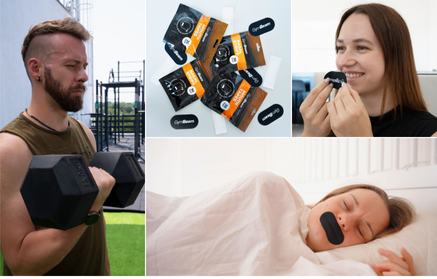
Nasal strips (nose strips) are self-adhesive strips with elastic lamellae that are applied to the bridge of the nose. These external nasal dilators (END) are used not only during sleep as anti-snoring strips, but also during sports activities, where they can help breathe better and easier, thus improving performance itself. [5]
Mouth strips (mouth tapes, sleep strips) are adhesive strips that are applied over the mouth to support nose breathing, especially during sleep. Their main purpose is to prevent spontaneous mouth opening during the night, which naturally improves nasal breathing. [10]
Mouth taping is a trend that is rapidly spreading among athletes, biohackers, and people who want to improve their sleep and respiratory health. Using the strip can also have a positive effect on proper diaphragm function, breath stabilisation, and body recovery. [10]

How Do Nasal and Mouth Strips Work?
The mechanism of action of both nasal and mouth strips is surprisingly simple, yet very effective. Each type targets a different aspect of breathing.
1. Effect of Nasal Strips
After application to the bridge of the nose, the strip gently stretches and lifts the nasal wings. This widens the nostrils and increases the space for airflow. The result is easier and more natural nose breathing without the need for drops or sprays to clear nasal passages. [1, 5]
The key benefit is reduced resistance during inhalation, which allows air to flow more freely through the nasal passages. And why does this matter so much? When resistance is lower, air flows through the nose more easily and with less effort. Breathing is thus deeper, smoother, and more efficient. You’ll appreciate this not only during sleep but also during sports, where quality breathing directly affects performance. [3]

2. Effect of Mouth Strips
Mouth strips have a different mechanism of action than nasal strips. They don’t open airways but gently close the mouth to support natural nose breathing during sleep. They are applied horizontally across the lips to keep them gently together. They don’t work by force but serve more as a physical reminder that helps keep the mouth closed and redirects breathing through the nasal passages.
This returns the body to its natural way of breathing, which is more efficient and healthier from a physiological perspective. Physical mouth closure also supports proper breathing posture. The tongue naturally rests against the upper palate, which helps maintain free space in the throat. Nasal breathing also creates slightly higher air pressure in the pharynx area, which can prevent soft tissue collapse and contribute to quieter and more stable breathing during sleep.
This is especially important for people who unconsciously breathe through their mouth, which can lead to dry mouth, snoring, poor oxygenation, or poor sleep. Mouth strips can thus be a simple and non-invasive helper on the path to healthier breathing and better rest. [11]

Why is it Better to Breathe through the Nose?
Nasal breathing is more natural than mouth breathing and brings many health benefits. [12–14]
Main Reasons to Breathe through the Nose more than the Mouth:
- Better air filtration: Nasal cavities catch dust, allergens, and microorganisms before they reach the lungs. They function as the first line of defence for the respiratory system.
- Humidifies and warms air: Air inhaled through the nose is humidified and warmed, which protects the respiratory tract mucous membranes from irritation and drying. This is especially important during sports or in winter.
- More efficient gas exchange: Deeper breathing supports body oxygenation and more efficient carbon dioxide (CO2) removal.
- Supports proper diaphragm function: Nasal breathing activates diaphragmatic breathing, which is deeper, more stable, and more efficiently oxygenates the body. This improves performance, concentration, and recovery.
- Maintains stable breathing rhythm: When breathing through the nose, breathing tends to be smoother and calmer, which has a positive effect on the nervous system and sleep quality.
- Increases nitric oxide (NO) production: Nose breathing stimulates nitric oxide production, which helps dilate blood vessels, supporting circulation and better oxygenation.
- Activates the parasympathetic system: Breathing through the nose stimulates the parasympathetic nervous system, which slows heart rate, reduces stress, and helps the body transition to a state of relaxation.
If you want to learn about other simple practices that will help you improve your health, read the article Feel Better Every Day. Simple Daily Challenges that Will Improve Your Health.
You might be interested in these products:
Greatest Benefits of Nasal Strips
1. Support Nose Breathing
Freer nose breathing is the first benefit you’ll feel immediately after applying a nasal strip. The greatest relief is often brought to people who have congested or narrowed nasal passages, whether due to allergies, colds, or seasonal rhinitis. It also helps with anatomical limitations such as a narrowed nasal valve (the narrowest part of the nasal cavity), a deviated septum, or a collapsing nasal wall. [1, 2, 5]
What Can Nasal Strips Do from a Study Perspective?
- increase the nasal valve cross-sectional area by 20–30%
- reduce nasal resistance by up to 27%
- improve the feeling of free breathing
- stabilise the lateral nasal wall
- reduce nasal congestion (feeling of stuffy nose) caused by allergies or colds
The result is deeper and more efficient breathing, which is beneficial during sleep, sports, and normal functioning. With easier nose breathing, the need to breathe through the mouth automatically decreases, which brings many other benefits. There is better filtration, humidification, and warming of air, which protects the respiratory tract from irritation. Nasal breathing also naturally engages the diaphragm, stabilises breathing rhythm, and ensures better body oxygenation. [1–3]

2. Help Reduce Snoring and Improve Sleep
Nighttime snoring is a problem that disrupts sleep not only for the person who snores but also for others around them. In many people, it’s caused by limited nasal airway patency, which leads to mouth breathing and soft tissue vibrations in the throat. This is what causes the unpleasant sound that’s the exact opposite of a lullaby and sometimes the cause of separate bedrooms. However, snoring can be solved by these nose strips, thus saving many a relationship. By expanding the nasal wings and increasing nose patency, they can facilitate nose breathing and reduce mouth breathing, and thus snoring. [4–5]
However, this effect only occurs if the cause is not a structural defect (deviated nasal septum) or sleep apnea (Obstructive Sleep Apnea – OSA). In healthy people with a feeling of a stuffy nose or only slightly impaired patency, they can work excellently. [4–5]
What Effect Do Nasal Strips Have on Sleep Quality from a Scientific Perspective?
- using nasal strips led to quieter and less frequent snoring in the studied couples, according to partner evaluations
- strips helped achieve better breathing and body oxygenation during sleep
- participants also reported improved sleep quality and decreased daytime sleepiness scores (Epworth Scale)
- after waking, they also recorded a reduced feeling of dry mouth
Are you interested in other tips on how to improve sleep? You’ll find the best ones in the article How To Fall Asleep Quickly? Try These Simple Tips For A Better Sleep.

3. Support Athletic Performance
Nasal strips are also used by many recreational and professional athletes. These include, for example, Spanish tennis player Carlos Alcaraz, one of Kenya’s leading marathoners Eliud Kipchoge, and Brazilian footballer Neymar Jr. They also confirm better breathing with less effort and faster recovery between periods of maximum performance.
However, they are also used by automotive and motocross racers who have restricted breathing due to helmets. The goal of sports nose strips is to make breathing more efficient, increase oxygen intake, carbon dioxide (CO2) elimination, thus supporting performance and recovery.

Studies show that nasal strips can be beneficial, especially during lower intensity performance, when a person can breathe through the nose. You probably also subconsciously switch to mouth breathing when, for example, running up a steep hill, doing burpees, or other demanding exercises. [6–8]
What other Effects Have Scientific Studies Shown?
- easier breathing during low to moderate exercise, such as running, hiking, or cycling
- subjectively easier inhalation and less breathing effort
- reduced need to breathe through the mouth during light training
- delayed transition to mouth breathing
- better body oxygenation during performance and recovery
However, some athletes did not observe these effects, so it can be said that it depends on subjective feeling. Therefore, it’s recommended to first try the strips on some shorter or lighter exercises and then evaluate how they suit you.
If you engage in endurance sports, where strips have the greatest significance, and you’re also interested in performance support supplements, you can learn about them in the article The 11 Best Supplements for Running, Cycling and Other Endurance Sports.
4. Enable Deeper Breathing During Yoga, Meditation, or Breathing Techniques
If you practice yoga, meditate, or practice various breathing techniques (such as the Wim Hof method), you know how crucial a calm and deep nasal breath plays. Nasal strips help maintain nasal passage patency, making breathing smoother and less strenuous. This leads to better diaphragm activation, more stable breathing rhythm, and overall calming of mind and body.
If you’re starting with yoga and are interested in its benefits, we recommend reading the article Yoga: The Key to Physical and Mental Balance.
5. Have Non-Invasive and Painless Use
One of the main advantages of nasal strips is their non-invasive and completely painless use. Simply stick them on the bridge of the nose and let them work. Moreover, they can be easily removed anytime without skin irritation, even with daily use. This makes them an ideal solution for anyone who wants to clear nasal passages without using nasal sprays and other invasive methods.

Greatest Benefits of Mouth Strips
The technique of taping the mouth during sleep (mouth taping) has recently been spreading mainly on social media as a simple “life hack” for better sleep. There are still only a limited number of scientific studies, so besides them, we also draw from the mechanism of action and experiences of people who have tried them. [15]
In the case of mouth strips, individual tolerance will play a major role. For some, the idea of having their mouth taped overnight can be very uncomfortable. It also depends on health status, as they are not suitable for everyone. The basic condition is problem-free nose breathing.
1. Support Nose Breathing and Sleep Quality
Mouth taping supports nasal breathing and thus deeper, better quality sleep. Thanks to this, you can wake up feeling fresher in the morning and have more energy during the day. [10, 16]
What Can Mouth Strips Do According to Studies?
- Deeper nose breathing extends deep and REM sleep phases, which are crucial for quality rest.
- Nose breathing creates a more continuous airflow, while mouth breathing can lead to irregular breathing and micro-awakenings.
- Study participants who slept with taped mouths reported less daytime sleepiness and a feeling of calmer sleep.
If you want to learn why sleep is important and what its lack causes, you can read about it in the article What Happens to Your Body When You Don’t Get Enough Sleep?

2. Help Reduce Snoring and Teeth Grinding
Mouth breathing is a common cause of snoring because it causes soft tissue vibrations. By closing the mouth, the probability of snoring is automatically reduced. Some users also report reduced teeth grinding (bruxism).
What Does Science Say about the Effect of Mouth Strips?
Promising results came from a small study that focused on people with mild obstructive sleep apnea: [16]
- Using mouth strips led to a 47% reduction in apnea index.
- 13 out of 20 patients recorded significant snoring reduction.
- The more pronounced effect was in participants who had a worse baseline condition.

3. Prevention of Dry Mouth and Support for Oral Health
If you breathe through your mouth during sleep, you surely know very well that unpleasant feeling of dry mouth in the morning after waking. However, this is also associated with disrupted oral microflora. This can then lead to greater tooth decay, gum inflammation, and bad breath. Therefore, nose breathing is more suitable from an oral hygiene perspective, which is also confirmed by studies. [17–19]
Why Breathe through the Nose According to Science?
- Nose breathing keeps mucous membranes moist and prevents them from drying out.
- People who breathe through their mouths have higher amounts of dental plaque and more frequently suffer from gum inflammation than those who breathe through their noses.
- Nasal breathing helps maintain the natural pH in the mouth.
- Taping the mouth during sleep supports proper jaw positioning.

4. They Have Non-Invasive and Painless Use
Mouth tapes represent a simple, non-invasive and painless solution for supporting nasal breathing during sleep. They are designed to be comfortably used every night and easily removed without skin irritation. Thanks to hypoallergenic adhesive and gentle design, they are suitable even for individuals with more sensitive skin.

Who are Nasal and Mouth Strips Suitable for?
Nasal strips help during sports, mouth strips improve breathing during sleep. During sleep, you’ll appreciate their combination, supporting nasal breathing to the fullest while utilising the benefits of both variants simultaneously. [9]
1. People who Want to Reduce Mouth Breathing
Both nasal and mouth strips support natural nasal breathing, which is more efficient, healthier and gentler on the respiratory system than mouth breathing.
2. People who Have Problems with Snoring
Both strips support healthier nasal breathing, which can reduce snoring.
3. Anyone who Wants to Improve Sleep Quality or Recovery
Thanks to more effective nasal breathing, you’ll support deeper relaxation and a feeling of freshness after waking up.
4. Athletes During Mild to Moderate Exercise
Nasal strips can extend the nasal breathing phase, make inhalation easier and improve comfort during training in cold or dusty environments. Ideal for endurance runners, cyclists, triathletes, skiers, cross-country skiers, motocross riders and yogis. According to individual preference, they’ll also be used by athletes who engage in more intensive activities, such as strength training, boxing or other combat sports.
5. Anyone who Practices Meditation
Deep nasal breathing has a calming and relaxing effect thanks to its action on the parasympathetic nervous system.
6. Individuals with Limited Nasal Patency
This is useful, for example, for allergies, a runny nose or a deviated nasal septum. Mechanical expansion of the nostrils facilitates airflow. Nasal strips are usually also suitable for pregnant women who have limited treatment options regarding medications and nasal sprays.
How to Use Nose and Mouth Strips?
1. Nasal Strip Application
The nasal strip is ideally applied just before sleep, sports activity or anytime during the day when you want to support nasal breathing.
- Clean and dry the skin: Before application, it’s advisable to thoroughly wash and dry the nose area. Avoid using greasy creams or balms that could reduce the strip’s adhesion.
- Degrease the skin for better adhesion: If the skin is greasier, we recommend gently wiping it with a cleansing or disinfecting wipe.
- Remove the protective paper: Carefully remove the backing film to reveal the adhesive side of the strip.
- Apply the strip across the nasal cartilage: Place it just above the nostrils so that it gently lifts the nasal wings and opens the nasal passages.
- Press and secure: Gently press the strip with your fingers for 5–10 seconds so it adheres well.
- Let it work: The strip usually stays in place for 6–8 hours, depending on skin type and level of activity.

2. Mouth Strip Application
- Clean and dry the skin around the mouth: Before application, thoroughly wash and dry your face. Avoid using greasy creams or balms that could limit the strip’s adhesion.
- Optionally degrease the skin: If the skin is greasier, we recommend gently wiping the mouth area with, for example, a cleansing wipe or cotton swab with micellar water.
- Remove the protective paper: Carefully remove the backing film to reveal the adhesive side of the strip.
- Apply the strip across the mouth: Place it horizontally across the lips so that it gently keeps them together.
- Press and secure: Press the strip with your fingers for 5–10 seconds so it adheres well and stays in place throughout the night.
- Use only if you can breathe comfortably through your nose: If you feel uncomfortable pressure, panic or have a blocked nose, remove the strip immediately. We recommend trying it first during rest or reading before you start using it overnight.

How Long should You Wear Nose and Mouth Strips?
- During sleep, they usually last at least 6–8 hours, depending on skin type, sweating and other factors.
- During sports or other activities, you can wear the nasal strip for the entire duration of the activity.
After removal, rinse your face and optionally apply moisturising cream to the skin, especially if you have sensitive skin.
Tips for Maximum Effect
- Clean and dry the skin: Before applying the strip, thoroughly wash your nose and gently dry it. Residues of cream, sweat or makeup can reduce adhesion.
- Press well: After applying the strip, gently press it with your fingers for 5–10 seconds so it adheres well and holds for the entire wearing time.
- Try different positions for the nasal strip: Every nose is different. Find the position where the strip best lifts the nasal wings and gives you the most relief.
- Start during the day: If you’re just starting with strips, we recommend trying them first during relaxation or reading. This way you’ll more easily recognise what effect they have on your breathing.

Most Common Mistakes when Using Nasal and Mouth Strips
Although using both nasal and mouth strips is very simple, small mistakes can affect their effectiveness. What should you watch out for?
- Insufficiently cleaned skin: Residues of cream, sweat, or makeup can significantly reduce the strip’s adhesion. This applies to both nasal and mouth strips. The result can be spontaneous detachment during the night or sports.
- Wrong strip placement: For nasal strips, a common mistake is applying it too low (on the tip of the nose) or too high. In such cases, it doesn’t properly lift the nasal wings. Mouth strips should be placed horizontally across the centre of the lips, not diagonally.
- Repeated use of one strip: Both aids are intended for single use. Reuse can lead to loss of shape, adhesiveness and reduced effectiveness.
- Use with severely blocked nose: If the nose is significantly blocked, for example during a cold, allergy or infection, the nasal strip may not work. You should preferably not use mouth strips at all in such cases. For mouth strips, freely passable nasal cavities are a prerequisite.

Risks and Contraindications of Nasal and Mouth Strips
Both nasal and mouth strips are generally safe, but there are situations where their use may not be appropriate or effective.
- Nasal deformities or structural obstacles: With a significantly curved nasal septum, narrowed nasal entrances or collapsing nasal walls, nasal strips may not function properly. Their effect may be limited and it’s advisable to consider consultation with an ENT doctor.
- Severely blocked nose or acute infection: If nasal breathing is significantly limited due to infection, allergy or inflammation, nasal strips may not help. In such cases, using mouth strips is also not recommended because the body needs the ability to breathe through the mouth.
- Hypersensitivity or skin irritation: In people with sensitive skin, eczema or adhesive allergies, redness or rash may appear at the application site. In such cases, it’s advisable to choose a hypoallergenic variant or discontinue use.
- Not suitable as a replacement for professional sleep apnea (OSA) treatment: Neither nasal nor mouth strips are intended for treating OSA.
- Not suitable for small children and people with breathing disorders: Mouth strips are not intended for small children or people with nasal breathing disorders or sleep apnea, unless specifically recommended by a specialist.
Nasal and mouth strips can be a great helper for improving breathing and sleep. However, they should not replace professional care or treatment of health problems. If you’re not sure whether they’re suitable for you, consult with a doctor.
Summary: Nasal vs. Mouth Strips – How to Choose?
| Purpose | Make nasal breathing easier during sports, a runny nose or sleep | Support nasal breathing during sleep by preventing mouth breathing |
| Main benefit | Widening nasal passages and reducing resistance during inhalation | Closing the mouth and redirecting breath through the nose |
| Mechanism of action | Mechanical lifting of nasal wings | Gentle mouth closure using adhesive tape |
| Suitability | During sports, blocked nose, runny nose, allergies, mildly deviated septum | During sleep, snoring, dry mouth, teeth grinding, supporting nasal breathing |
| Risks and limitations | Ineffectiveness with serious anatomical obstacles, skin irritation | Not suitable with a blocked nose, sleep apnea, or for children with breathing disorders |
| Recommended for goals | Sports, meditation, breathing exercises, reducing mouth breathing | Improving sleep quality, reducing snoring, oral hygiene, respiratory health |
What Should You Remember?
Nose and mouth strips are simple aids that can improve your daily life. Anyone can master their application and they find use in many areas. Nasal strips will make breathing easier during sports at low to moderate intensity and will also help open airways during meditation, rest or sleep. Mouth strips find application during sleep, especially for people who tend to breathe through their mouths. This way they can prevent snoring, dry mouth and other negative consequences of breathing through the mouth. However, these are not medical devices. If you have breathing problems, consult your issues with a doctor.
Did you like the article and find it useful? Share it with friends and help them discover the benefits of proper breathing.
[1] Schenkel, E. J., Ciesla, R., & Shanga, G. M. Effects of nasal dilator strips on subjective measures of sleep in subjects with chronic nocturnal nasal congestion: A randomized, placebo-controlled trial. – https://doi.org/10.1186/s13223-018-0258-5
[2] Peltonen, L. I., Vento, S. I., Simola, M., & Malmberg, H. Effects of the nasal strip and dilator on nasal breathing—A study with healthy subjects. – https://pubmed.ncbi.nlm.nih.gov/15521663/
[3] RECINTO, C., EFTHEMEOU, T., BOFFELLI, P. T., & NAVALTA, J. W. Effects of Nasal or Oral Breathing on Anaerobic Power Output and Metabolic Responses. – https://doi.org/10.70252/EHDR7442
[4] Ulfberg, J., & Fenton, G. Effect of Breathe Right nasal strip on snoring. – https://pubmed.ncbi.nlm.nih.gov/9299650/
[5] Dinardi, R. R., de Andrade, C. R., & Ibiapina, C. da C. External nasal dilators: Definition, background, and current uses.– https://doi.org/10.2147/IJGM.S67543
[6] Baker. Study Shows Athletes Get No Kick From Nasal Strips. – https://www.buffalo.edu/news/releases/1998/06/3376.html
[7] The Effect of Nasal Breathing Versus Oral and Oronasal Breathing During Exercise: A Review. – https://doi.org/10.18488/journal.90.2020.71.1.10
[8] Evaluation of the effectiveness of the external nasal dilator strip in adolescent athletes: A randomized trial—ScienceDirect.– https://www.sciencedirect.com/science/article/abs/pii/S0165587613003005
[9] ScienceDirect Topics. Nasal Dilator—An overview.– https://www.sciencedirect.com/topics/nursing-and-health-professions/nasal-dilator
[10] Some people claim taping your mouth shut helps you sleep better—But what are the risks? – https://www.nationalgeographic.com/science/article/mouth-tape-sleeping-hygiene-hacks-social-media
[11] Sleep Foundation. Mouth Taping for Sleep: Does It Work? – https://www.sleepfoundation.org/snoring/mouth-taping-for-sleep
[12] Physiology Of Respiration—Respiratory System, Breathing, Gas Exchange Mechanism, Regulation—Biology Notes Online. – https://biologynotesonline.com/physiology-of-respiration-respiratory-system-breathing-gas-exchange-mechanism-regulation/
[13] Lörinczi, F., Vanderka, M., Lörincziová, D., & Kushkestani, M. Nose vs. Mouth breathing– acute effect of different breathing regimens on muscular endurance. – https://doi.org/10.1186/s13102-024-00840-6
[14] Yu, S., Wang, D., Guo, Y., Shen, S., & Wang, J. Numerical study on the distribution of nitric oxide concentration in the nasal cavity of healthy people during breathing. – https://doi.org/10.1016/j.niox.2022.11.002
[15] Fangmeyer, S. K., Badger, C. D., & Thakkar, P. G. Nocturnal mouth-taping and social media: A scoping review of the evidence. – https://doi.org/10.1016/j.amjoto.2024.104545
[16] Lee, Y.-C., Lu, C.-T., Cheng, W.-N., & Li, H.-Y. The Impact of Mouth-Taping in Mouth-Breathers with Mild Obstructive Sleep Apnea: A Preliminary Study. – https://doi.org/10.3390/healthcare10091755
[17] Kaur, M., Sharma, R. K., Tewari, S., & Narula, S. C. Influence of mouth breathing on outcome of scaling and root planing in chronic periodontitis. – https://doi.org/10.1038/s41405-018-0007-3
[18] BS, T. L. S., RDH. Mouth Taping: Viral Fad or Evidence-Based Treatment for Mouth Breathing? – https://www.todaysrdh.com/mouth-taping-viral-fad-or-evidence-based-treatment-for-mouth-breathing/
[19] Biology Insights. Mouth Taping: Effects on Breathing and Sleep Patterns. – https://biologyinsights.com/mouth-taping-effects-on-breathing-and-sleep-patterns/
Add a comment