

Table of Contents
With the arrival of November, moustaches are starting to appear on the faces of many men, which this time are not just a fashion accessory. They symbolise support for the Movember movement, a global initiative that has been changing the way men approach their health since 2003.
Behind its inception are two friends and a simple idea – to raise awareness about men’s mental health and diseases such as testicular and prostate cancer. From a small idea, it gradually grew into a movement that today connects millions of people worldwide and brings both hope and inspiration.
Prostate cancer is the second most common cancer in men and also the fifth most common cause of cancer deaths in men worldwide. However, Movember reminds us that prevention and early diagnosis can save lives. Let us therefore look at why it is important to talk openly about men’s health and how you can support not only your loved ones but also yourselves.[5]
What is Movember and why is it Important?
Today, Movember is known as a global movement that has been uniting millions of people since 2003 in a common effort to improve awareness of men’s health and save lives. However, it started very simply. Two friends from Australia, inspired by a women’s initiative focused on breast cancer, encouraged their acquaintances to grow moustaches and thereby support a topic often kept silent – men’s health. From thirty friends, a movement was born that is now changing the world.[11]

Movember Focuses on Three Key Areas
- Testicular cancer – raises awareness of its symptoms and the need for early diagnosis, especially in young men aged 15 to 35, who are most at risk.
- Prostate cancer – promotes prevention, regular check-ups, and awareness of treatment options.
- Mental health and suicide prevention – seeks to break the taboo surrounding mental health issues and show that talking about them is a sign of strength, not weakness.
The aim of the entire campaign is to spread awareness, support research, and motivate men towards prevention. In addition to moustaches, which have become an iconic symbol of Movember, the blue ribbon is also often used; however, this is not a symbol exclusively for Movember, but generally expresses support for prostate cancer awareness and men’s health. As these themes overlap, the blue ribbon is often associated with the Movember movement as well.
The MOVE for Movember challenge is also gaining prominence, encouraging participants to walk or run a symbolic 60 kilometres per month. This number represents 60 men who die by suicide every hour worldwide.
In this way, Movember connects physical and mental health and reminds us that taking care of yourselves is not a sign of vanity, but of courage.[16]

1. Testicular Cancer: How to Prevent and Diagnose Early?
Testicular cancer is among the rarer malignant diseases – it accounts for only approximately 1% of all cancers in adult men. Nevertheless, it is insidious in whom it affects. It most commonly appears in young men aged 15 to 35, with the most common age being 25 to 29 years.
This type of cancer originates in the testicles, which are male gonads responsible for sperm production and the hormone testosterone. Although it is a disease with a high cure rate, it is important to detect it early. The key is early recognition of symptoms and regular self-examination. [2]
Risk Factors for Testicular Cancer
In many diseases, lifestyle plays a significant role – for example, smoking, alcohol, or an unhealthy diet. However, with testicular cancer, it is a bit different. This type of cancer is not among the diseases directly influenced by lifestyle, which makes it an even more unpredictable adversary.
The causes of its onset are not yet fully understood, but experts know several factors that significantly increase the risk of the disease:
- Undescended testicle (cryptorchidism): The most significant risk factor. The risk of tumour development is higher in the undescended testicle, but it is also slightly increased in the other, healthy testicle. Surgical correction in childhood can significantly reduce the risk. [15]
- Personal history: Men who have already had cancer in one testicle have a higher probability that the disease will also appear in the other. [15]
- Family history: If testicular cancer has occurred in a close relative, such as a father or brother, the risk also increases.[2,15]
Since these factors cannot be avoided, early diagnosis and regular check-ups remain the most effective protection.
You might be interested in these products:
What are the Symptoms of Testicular Cancer?
Testicular cancer is insidious in that it often causes no symptoms at the beginning. That is why it is important that you
Furthermore, the testicles are easily accessible for self-examination, so detecting a problem early is literally in your own hands.
Watch out if You Notice any of these Symptoms:
- Unusual lump or swelling in either testicle (usually painless).
- Feeling of heaviness or tension in the scrotum.
- Dull ache or unpleasant pressure in the scrotum, testicle, or groin.
- Sudden accumulation of fluid in the scrotum.
- Enlargement or tenderness of breast tissue (rarely).[18]
If you notice any of these symptoms in yourself, do not wait and make an appointment with a doctor.
How is Testicular Cancer Treated?
The good news is that testicular cancer is among the most treatable types of cancer. Treatment depends on the type and stage of the disease, but usually includes:
- Surgical procedure (orchiectomy) – removal of the affected testicle, which is often the first and only step of treatment.
- Radiotherapy or chemotherapy, if the cancer has spread beyond the testicle.
If you are attentive to your body and do not postpone preventive check-ups, you have a great chance to detect the disease early and recover with minimal consequences. [19]

How to Prevent Testicular Cancer?
Unlike many other diseases, with testicular cancer, there is no reliable evidence that its onset can be prevented by lifestyle changes. Factors such as a healthy diet, exercise, or smoking do not play a decisive role here.
However, this does not mean that you are without the option to act. On the contrary,
Men who detect symptoms in the early stage have the greatest chance of successful treatment. In addition to self-examination, genetic testing can also play an important role in some cases, especially if testicular cancer has occurred in your close relatives.
The basis of prevention is therefore not a change in lifestyle, but a responsible approach to your own health. And that begins with one simple step – regular testicular self-examination.
Testicular Self-Examination Procedure
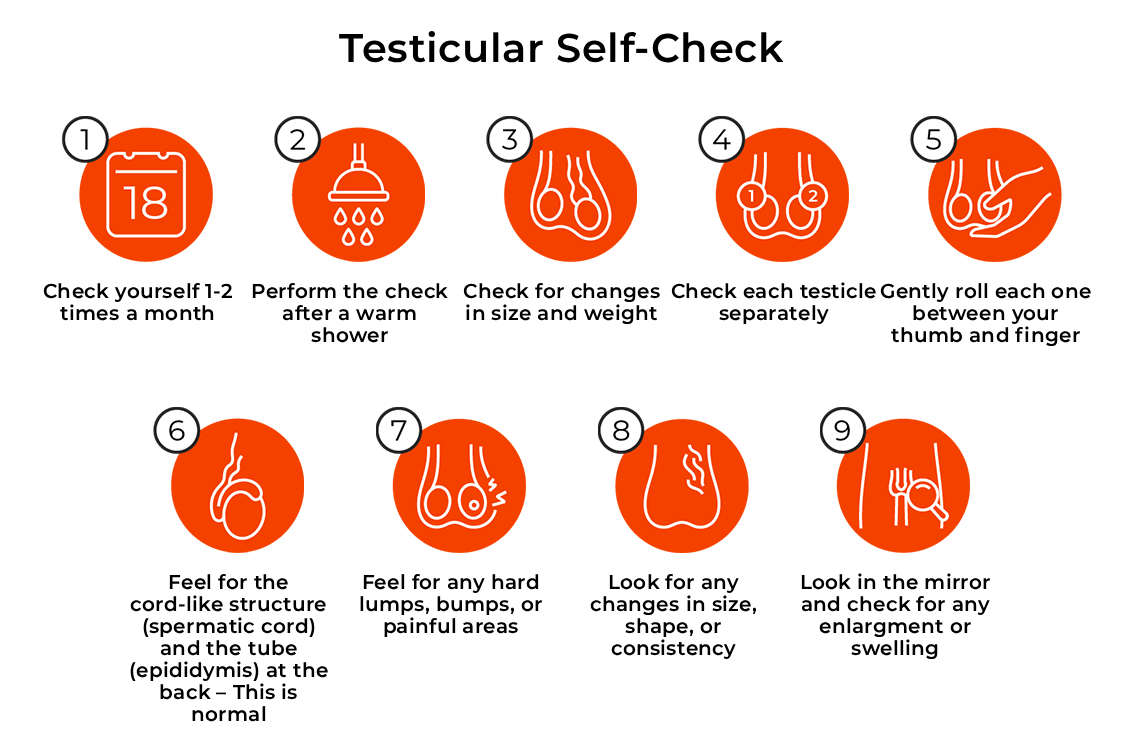
- Examine yourselves once or twice a month.
- Examine yourselves after a warm shower. Heat helps relax the testicles, making it easier to feel even small changes.
- Check for changes in size and weight. Both testicles should be approximately the same size and consistency, but minor differences are common.
- Examine each testicle separately.
- Gently palpate them between your thumb and fingers. Proceed carefully so that you can feel the surface of the testicle and detect any changes.
- Feel for a cord-like structure (spermatic cord) and a thin tube behind the testicle (epididymis) – these are normal parts of the anatomy that do not indicate a problem.
- Look for hard lumps, bumps, or painful areas. If you discover any unusual change, monitor whether it persists and consult a doctor.
- Look for changes in size, shape, or consistency. Testicles should be smooth and firm, but not hard.
- Examine yourselves in the mirror. Observe whether you see swelling, changes in skin colour, or enlargement of one of the testicles.
2. Prostate Cancer: How to Prevent and Diagnose Early?
Prostate cancer is a reality that many men face more often than they would wish. It is the most common type of cancer in men in Europe and also the second most common cause of cancer deaths worldwide.[21]
The prostate is a small, walnut-sized gland located beneath the bladder that produces fluid forming part of semen. Although its diseases often appear only in older age, it is important to know about them earlier, because early detection can save lives.
The good news is that if prostate cancer is detected early, treatment is very successful in most cases. The five-year survival rate in many countries is over 90%, which is clear proof that prevention and regular check-ups truly pay off.
Risk Factors for Prostate Cancer
Unlike testicular cancer, which more often affects younger men, prostate cancer primarily appears in older age. Significant roles are played by age, genetics, and also lifestyle.
Main Factors that Increase the Risk of Cancer:
- Age: The risk significantly increases after fifty. More than 60% of all cases are diagnosed in men over 65 years of age. Therefore, during this period of life, you should be even more attentive to your health. [1]
- Family history: If prostate cancer has occurred in your father, brother, or son, your risk is more than double. If the disease was diagnosed in a relative at a younger age, the risk increases even further. [13]
- Overweight and obesity: Higher body weight is associated with an increased risk of advanced and more aggressive forms of prostate cancer. Adipose tissue affects hormonal balance and promotes chronic inflammation in the body, which can contribute to tumour development. [4]
- Nutrition and lifestyle: A diet high in red meat and fatty dairy products, along with low consumption of fruits and vegetables, can increase the risk of prostate cancer. Similarly, a lack of physical activity also has a negative impact. [3]
You cannot influence all of these factors, but you have the power to reduce the risk with those you can influence. For example, through a healthier lifestyle, exercise, and regular check-ups.

What are the Symptoms of Prostate Cancer?
Prostate cancer is insidious in that it usually causes no symptoms in its early stages. Many men only learn about it during screening tests or a preventive check-up. That is why it is so important that you go for regular check-ups. Even when you feel completely healthy.
Since the prostate surrounds the urethra, the first symptoms are often associated with urination.
How Does Prostate Cancer Manifest?
- Frequent urge to urinate, especially during the night.
- Weak or interrupted urine stream.
- Feeling that the bladder has not completely emptied.
- Pain or burning during urination.
In more advanced stages, pain in the lower back, pelvis, or hips may also appear, or blood in the urine or semen.
If you notice any of these symptoms, do not delay visiting a doctor. It might be something less serious, such as inflammation, but only a professional examination can definitively determine the cause. Early detection of prostate cancer fundamentally increases the chance of successful treatment.
How is Prostate Cancer Treated?
The method of prostate cancer treatment depends on the stage of the disease, the aggressiveness of the tumour, and the patient’s overall health. The good news is that thanks to early diagnosis, most cases detected early have a very favourable prognosis.
If you are among the men who regularly go for check-ups, you have a great chance that any potential disease will be detected in its early stage. That is, at a time when treatment is most effective.
The Main Treatment Options Include:
- Active surveillance: For slow-growing, low-risk tumours, a conservative approach is often chosen. This means that your doctor will regularly monitor you through PSA tests and biopsies.
- Surgical procedure (radical prostatectomy): Removal of the entire prostate, performed primarily in cases of localised tumours.
- Radiotherapy: Radiation focused on destroying cancer cells. It is used either as a primary treatment or in combination with other methods.
- Hormone therapy: Reduces the level of male hormones (androgens), which promote the growth of cancer cells.
Each case is individual, so treatment is always tailored to the specific patient. If you communicate openly with your doctor and regularly undergo preventive examinations, you will increase your chance of successful treatment and a full life.
How to Prevent Prostate Cancer?
Prostate cancer is often asymptomatic in its early stages and therefore can remain hidden until it is too late. That is why it is so important to regularly undergo preventive examinations (screening) so that you have a chance to detect the disease early.
1. Screening and Early Diagnosis
Screening means an examination for men who have no symptoms, with the aim of detecting the disease at the earliest possible stage. In practice, this means a simple PSA blood test (prostate-specific antigen), which measures the level of a protein produced by the prostate. Elevated values can signal a problem that requires further examination – for example, a digital rectal examination (DRE) or imaging methods.
European Union countries are being called upon to actively support this screening and to conduct widespread testing of men who have an increased risk of developing prostate cancer. Currently, it is recommended especially for men aged 50 to 70 years, or earlier if they have an increased risk (for example, if prostate cancer occurred in their father or brother). Subsequently, testing is repeated every 2 to 4 years.

2. Lifestyle Changes
Although lifestyle changes do not guarantee that you will prevent prostate cancer, there is evidence that healthy habits can reduce the risk of advanced forms of the disease and improve overall health. What can be done for this?
1. Maintain a Healthy Weight
Maintaining a healthy body weight is one of the most effective steps to reduce the risk of many diseases, including prostate cancer. Obesity is particularly associated with more aggressive forms of this disease.
Monitor your diet, avoid excessive calorie intake, and strive for a balance between energy intake and expenditure.[12]
- You can read about when we consider body weight unhealthy in the article Obesity, Overweight, and Optimal Body Weight: Where Is the Line, and Why Is Obesity Not Healthy?
- If you need to lose weight, the article Simple Weight Loss Basics: You’ll Be Surprised What’s Really Important might help you.
2. Exercise Regularly
Physical activity plays an important role in preventing prostate cancer, especially its more aggressive forms. Research shows that men who exercise regularly have a lower risk of developing and worsening the disease. Physical activity helps maintain healthy hormone levels, reduces inflammatory processes, and supports proper functioning of the immune system.
It doesn’t have to be elite sports – what’s important is regularity and intensity appropriate to your capabilities. It is recommended to do at least 150 minutes of moderate-intensity exercise per week, such as brisk walking, swimming, cycling, or running.[14]
- When you go to the gym, we can advise you on planning your workouts in the article How to Create a Quality Gym Training Plan?
- If you prefer to exercise at home, you might find this advice useful: How to Create an Effective Home Workout Plan?
- It’s not always possible to set aside time for training, so you’ll definitely appreciate our 10 Tips on How to Stay Active When You Don’t Have the Time to Go to the Gym.

3. Eat Healthily
Diet has a direct impact on your health.
- Prefer plant-based foods – vegetables, fruits, whole grains, nuts, and legumes.
- Limit red and processed meats, fatty dairy products, and foods high in sugar and saturated fats.
Research suggests that foods rich in lycopene (tomatoes, melon, pink grapefruit) and omega-3 fatty acids from fish or flaxseeds may also be beneficial.[9]
- You can read about how to create a balanced diet in the article What is a Healthy Diet and How to Learn to Eat Healthy?
- We’ll advise you on meal planning in the article Tailored Meal Plan: Complete Guide on Planning Your Diet Based on Calories and Macros.
4. Avoid Smoking
Smoking is a risk factor for many types of cancer. If you smoke, quitting this habit is one of the best steps you can take for your health.[8]
3. Men’s Mental Health
While we usually notice physical illnesses quickly, mental health often suffers silently. That’s why it has become one of the main pillars of the Movember campaign, which, in addition to physical health, also draws attention to suicide prevention and men’s mental well-being. It is estimated that more than 700,000 people worldwide decide to end their lives annually. Moreover, the suicide rate among men is almost twice as high globally compared to women. [17]
Although problems such as anxiety or depression affect both men and women equally, men still face social pressure that prevents them from openly talking about their feelings. This stigma then causes many men to suppress their problems and not seek help until it’s too late.
How to Take Care of Mental Health?
Taking care of your psyche is just as important as taking care of your body. Our brain, mind, and body form one interconnected whole, and if we neglect one, we weaken the other. Mental health doesn’t require drastic changes from day to day. It’s enough to start with small steps that you can incorporate into your daily life.
1. Exercise Regularly
Regular physical activity is one of the most effective ways to support mental well-being. It helps reduce stress hormones while increasing levels of endorphins, the happiness hormones.
You don’t need to perform great athletic feats. Even brisk walking, swimming, yoga or cycling several times a week can significantly improve mood and reduce anxiety. According to studies, regular physical activity can alleviate symptoms of depression as effectively as some medications.[7]
2. Support Your Brain with Nutrition
What you eat affects not only your body but also your mind. A balanced diet rich in fruits, vegetables, whole grains, nuts, legumes, fish and healthy fats (e.g., omega-3 fatty acids) supports brain function and helps improve mood.
Conversely, excessive consumption of highly processed foods, simple sugars and saturated fats can contribute to fatigue, irritability, and increased anxiety.
3. Learn to Manage Stress
Stress is a normal part of life, but if it lasts too long, it can affect your psyche with exhaustion, irritability, or loss of motivation. It helps to learn to recognise when tension starts to build up and consciously release it.
Simple techniques that you can incorporate into your everyday life are effective, such as deep breathing, short meditation, writing down your thoughts or taking a walk in fresh air. By regularly releasing stress, you can reduce the risk of anxiety or depressive states.[6]
4. Get Enough Sleep
Quality sleep is often underestimated, but without it, the psyche quickly becomes exhausted. Lack of sleep increases irritability, worsens concentration, and can deepen depressive moods.
Allow yourself 7 – 9 hours of sleep daily, ideally at the same time.
5. Build Quality Relationships
Maintaining contact with close people has a big impact on mental well-being. If you’re going through a difficult period, sharing feelings with someone you trust is often the first step to relief. Research confirms that supporting social bonds reduces the risk of depression and improves overall mental health.[10]
- If you want to take better care of yourself, you might be interested in the article Self-care: How to Take Care of Yourself and Be More Satisfied in Life.
- The article 11 Ways to Maintain a Healthy Mindset can help you with positive thinking.

What to Do when You Already Have Mental Health Problems?
Each of us has periods when we feel under pressure, tired, or without energy. However, if these feelings last longer and interfere with everyday life, it’s time to pay attention to them. Mental difficulties are not unusual; they can affect anyone, regardless of age or personality.
The most important thing is not to stay alone with them. Therefore, the sooner you seek help, the easier it will be to recover from the problems.
1. Talk to Someone
Start by talking to someone you trust. It could be a friend, partner, family member, or colleague. Just talking about your feelings out loud helps release tension and look at things from a different angle.
2. Turn to a Professional
If the condition doesn’t improve or you feel you can’t handle it on your own, turn to a psychotherapist or psychiatrist. These professionals can help you understand what’s happening and find a way to feel better.
3. Contact a Crisis Hotline
If you feel the situation is beyond your strength, don’t wait for it to improve on its own. Help is available even when you don’t know where to start. You can turn to crisis helplines or support services that are anonymous and operate 24/7.
How to Help a Loved One?
What if it’s about the mental health of a friend, family member, or colleague? Certainly don’t be indifferent to it, but try to help. You can be inspired by the simple ALEC model:
- Ask – Ask how they really are. Show that you care about them.
- Listen – Listen without judging. Sometimes the biggest help is just silence and presence.
- Encourage Action – Support them in taking the next step – visiting a doctor, therapist, or support group can make a big difference.
- Check in – Contact them again in a few days. Let them know they’re not alone in this.
Even a small gesture, like a simple phone call or meeting for coffee, can save someone’s day or even life.

How Can You Get Involved in the Campaign?
1. Grow a Moustache
The most famous symbol of Movember, the moustache, is a way to draw attention to yourself and open a discussion about men’s health. Every look in the mirror or question from an acquaintance reminds us why it’s important to talk about these topics.
2. Move for a Good Cause
Join the MOVE for Movember challenge. Walk or run 60 kilometres during November. Each kilometre symbolises one of the 60 men who lose their lives to suicide every hour worldwide.
3. Organise Your Own Challenge or Event
You can organise a sports event, fundraiser, company challenge, or online campaign. The goal is to connect people and talk about men’s health.
4. Support Financially
If you don’t want to get actively involved, you can contribute financially. The proceeds from the campaign help fund research, education, and programs to support men’s mental health worldwide.
5. Share the Idea of Movember
Even if you want to grow a moustache, you can talk about prevention or your experiences. Even an ordinary conversation can help someone take the first step towards taking care of their own health.
What Should You Take Away from This?
Movember reminds us every year that caring for men’s health should not be a topic for just one month. Moustaches are indeed the most visible symbol of the campaign, but real change happens in your approach to yourselves. In prevention and responsibility for your own body and mind.
Testicular cancer and prostate cancer are among the diseases that are successfully treatable in most cases with early diagnosis. It takes just a few simple steps, such as monthly self-examination, regular check-ups with a doctor after fifty, and a healthy lifestyle. These are small decisions that can save a life.
Equally important is not neglecting mental health. Men still make up the majority of suicide victims worldwide, and that’s why it makes sense to talk about these topics. If you don’t feel well, it’s not shameful to ask for help.
Embrace Movember as a challenge to be honest with yourselves, take care of your health, and inspire others to do the same.
Get involved in the campaign and share information, as well as your completed mileage. And send this article to your father, brother, or friend who also needs to take care of their health.
[1] CDC Prostate Cancer Risk Factors. – https://www.cdc.gov/prostate-cancer/risk-factors/index.html
[2] GIONA, S. The Epidemiology of Testicular Cancer. – http://www.ncbi.nlm.nih.gov/books/NBK585983
[3] MD, H.E.L. What lifestyle changes can help me avoid prostate cancer? – https://www.health.harvard.edu/mens-health/what-lifestyle-changes-can-help-me-avoid-prostate-cancer
[4] PARKER, J. Body weight and risk of prostate cancer – https://www.oncology-central.com/body-weight-and-risk-of-prostate-cancer-the-wcrf-perspective
[5] RAWLA, P. Epidemiology of Prostate Cancer. – https://pmc.ncbi.nlm.nih.gov/articles/PMC6497009/
[6] READ, 5 Min How stress affects your health. – https://www.apa.org/topics/stress/health
[7] SMITH, P.J. - MERWIN, R.M. The Role of Exercise in Management of Mental Health Disorders: An Integrative Review. – https://pmc.ncbi.nlm.nih.gov/articles/PMC8020774/
[8] WILSON, K.M. et al. Lifestyle and dietary factors in the prevention of lethal prostate cancer. – https://pmc.ncbi.nlm.nih.gov/articles/PMC3720164/
[9] ZUNIGA, K.B. et al. Diet and Lifestyle Considerations for Patients with Prostate Cancer. – https://pmc.ncbi.nlm.nih.gov/articles/PMC7293879/
[10] Mental health. – https://www.who.int/news-room/fact-sheets/detail/mental-health-strengthening-our-respons
[11] Movember. – https://us.movember.com/about/history
[12] Prostate Cancer – https://www.aicr.org/cancer-survival/cancer/prostate-cancer
[13] Prostate Cancer Prevention - NCI. – https://www.cancer.gov/types/prostate/patient/prostate-prevention-pdq
[14] Prostate Cancer Prevention and Risk Factors | OSUCCC – James. – https://cancer.osu.edu/for-patients-and-caregivers/learn-about-cancers-and-treatments/cancers-conditions-and-treatment/cancer-types/genitourinary-cancers/prostate-cancer/prevention
[15] Risk Factors for Testicular Cancer. – https://www.cancer.org/cancer/types/testicular-cancer/causes-risks-prevention/risk-factors.html
[16] Run or walk 60km this Movember to support men’s health. – https://cz.movember.com/en/support-us/move
[17] Suicide worldwide in 2021: global health estimates. – https://www.who.int/publications/i/item/9789240110069?utm_source=chatgpt.com
[18] Testicular cancer - Symptoms and causes. – https://www.mayoclinic.org/diseases-conditions/testicular-cancer-care/symptoms-causes/syc-20352986
[19] Testicular Cancer Screening - NCI. – https://www.cancer.gov/types/testicular/patient/testicular-screening-pdq
[20] Testicular Cancer Screening - NCI. – https://www.cancer.gov/types/testicular/patient/testicular-screening-pdq
[21] What Are the Survival Rates for Prostate Cancer? – https://www.cancer.org/cancer/types/prostate-cancer/detection-diagnosis-staging/survival-rates.html
Add a comment