
Table of Contents
The skipping rope is an exercise tool that almost everyone has encountered in their lifetime, at least in their gym classes at school. You may have avoided it ever since, as it perhaps reminded you of a strict PE teacher from back then. However, after reading today’s article, it is likely that you will give it a second chance. It really deserves it. And perhaps you’ll even come around to thank that PE teacher for giving you a solid foundation that’s going to make your return to the skipping rope a little easier.
Jumping rope has been a growing trend among athletes in recent years. This is mainly due to the popularization of CrossFit, in which the skipping rope has a place of honour. Boxers, too, commonly known for their incredible physical condition, are immensely fond of skipping ropes and regularly use it as a part of their training plan. This intense activity has a number of benefits not only for top athletes, but for anyone looking to get in shape, work on their dynamics and explosiveness or simply to lose weight and do something for their health.
In addition to talking about the biggest advantages of skipping, this article will also help you decide what kind of skipping rope to choose and how to adjust it correctly. You will learn all the essentials about skipping rope exercises and in the end we’ll show you a model training using it.

Boxers and crossfit athletes use skipping rope to get in shape. Here are 10 reasons why pick it up, and how to go about it
Sport generally brings a lot of benefits to our lives, which is why we should make it an integral part of them. There are days when you have enough time and energy to enjoy a relaxing two-hour bike ride. But then there are also days when you have to submit your big project at work, or when you have to study for your big exam, and all you have are a few precious minutes off. You want to use those as effectively as possible. When you are looking for a training that only takes a minimum of your time, while ensuring the maximum number of calories burned and endorphins released, jumping rope will be the right kind of workout for you. What other benefits can it bring to your life?
1. You’ll burn a lot of calories
Skipping rope is no doubt a high intensity activity. Every minute you spend off the ground costs a lot of effort, which reflects in the amount of calories burned. By skipping a rope, a 60 kg female can burn a whopping 693 kcal an hour. That clearly doesn’t mean she’d have to skip for 60 minutes a day to achieve results. Jumping 5 times a week for only 30 minutes (347 kcal), she can lose up to 190 grams of fat a week. That’s 760 g per month and over 9 kg per year. Those are some interesting numbers for just 30 minutes a day, wouldn’t you agree? To learn more about how much fat you can lose through a variety of other activities, read our article How to Lose a Kilogram of Fat, and How Much Energy Is Really Hidden in It?
Table: How much energy does a 60 kg female burn in 30 minutes of these high-intensity activities? [1–2]
| Activity | Calories burned in 30 minutes | *Equivalent in food |
|---|---|---|
| Skipping rope | 347 | 40 g of oatmeal with 20 g of protein, 15 g of peanut butter and 100 g of strawberries |
| High intensity swimming | 309 | 40 g of oatmeal with 20 g of protein, 9 g of peanut butter and 100 g of strawberries |
| High-intensity workout on a rowing machine | 268 | 40 g of oatmeal with 15 g of protein, 5 g of peanut butter and 100 g of strawberries |
| High intensity strength training using weights | 240 | 30 g oatmeal with 15 g protein and 50 g strawberries |
2. You will lose weight fast
It is clear from the previous point that you can burn a decent amount of calories just by jumping rope. That of course goes hand in hand with weight loss. In order to lose weight, you need to create a caloric deficit, which you achieve by expending more energy than you take in. Skipping rope can contribute to this effort significantly as it burns more energy than most other sports activities, resulting in a considerable advantage. This is evidenced by a study that compared the effects of skipping rope and riding on an exercise bike for the same amount of time for 3 times a week. The jumping group had better results in VO2 max values and also exhibited a greater reduction in body weight expressed by a lower BMI compared to the cycling group. [3–5]
A good combination of cardio, strength training and an adjusted diet is what makes for an effective weight loss. All this is enhanced by sufficient sleep and regeneration. If you are interested in losing weight, you will certainly find the information in this article useful: Weight Loss Basics: You’ll Be Surprised What Really Matters.
You might be interested in these products:
3. You’ll strengthen your core and legs
Skipping your way to some solid abs without doing boring crunches every day? Not entirely a pipe dream. Rope exercise activates your deep stabilization system, more commonly known as your core, which is important in any physical activity – whether you’re doing squats at gym or carrying a heavy shopping bag back home.
If you’ve dusted off your old skipping rope and incorporated it into your training routine recently, it’s possible that you’ve woken up with some entirely new muscle sores. That’s right, you’re feeling your calves.
Calves are so much more important than we normally take them for. These often overlooked muscles are crucial for every step we make. Skipping rope targets and strengthens these muscles.
But that’s not all. Your forearms and wrists will feel the burn too. Skipping rope incorporates muscles all around your body and helps them develop, becoming bigger and stronger. [6–7]
You can also exercise your midsection within a circuit training routine, which you can read more about in our article: Strengthen Your Core with This Ab Circuit Workout
4. You will improve your coordination, explosive power and dynamism
Boxers, crossfit enthusiasts, as well as other athletes use skipping rope not only to improve their overall physical condition, but also to develop a variety of skills that translate effectively into the framework of their particular sports.
Working out with a rope improves your overall agility, endurance, speed, and above all, your movement coordination. While skipping, you really have to focus and synchronize the movements of your upper and lower body.
Doubly so once you get into performing some advanced “tricks” such as double unders or skipping on one leg. [8–9]
5. It will improve the health of your heart and lungs, as well as the overall physical fitness
It is generally known that sports have a beneficial effect on the health of heart and lungs. Skipping rope is no exception. For example, a study of obese teenage girls at high risk of developing cardiovascular disease has yielded interesting results. After 12 weeks of training with a skipping rope, the participants exhibited changes in terms of reduction in the amount of body fat, waist circumference, blood pressure, blood glucose as well as in their levels of insulin. In addition to the proper functioning of the heart, these positive changes might have also influenced the overall health of the studied sample group of teenagers. [10]
Another study looked at the effect that 7 weeks of skipping rope would have on speed, endurance and agility in adolescent students. Participants jumped 3 times a week for 15-50 minutes and the results showed significant positive changes in their endurance, agility and also a slight improvement in speed. [11]
Of course, anybody, not just students, can improve their physical condition thanks to the skipping rope. Further scientific work was aimed at adult men who jumped twice a day for a total of 5-10 minutes for the span of 5 weeks, with the intensity of their skipping training increasing on week by week basis. As a result, better VO2 max values were observed, which is a practical indicator of the increase in physical condition. [12]
6. It will improve the natural solidity of your bones
With every jump you make, you end up landing on a hard surface, which makes your bones adapt and strengthen so as to absorb enough shock without getting damaged. This mechanism is the most likely cause for the effect we observe in athletes who skip rope frequently – the natural mineral density of their bones is improved and their bones are there for a lot more solid.
The higher the mineral density of your bones, the lower the risk of breaking them or of suffering from osteoporosis. If you want to provide your bones with some additional absorption during your skipping, try using a mat, another added benefit of which is that your neighbours are much less likely to complain. [13–15]
7. Skipping rope is cheap and easy to store
If you can’t find your old skipping rope from childhood, or would simply prefer to have a new one due to having grown an inch or two since then, you don’t have to worry about your budget for it. You can always start with a more basic model, which is among the cheapest gym tools around.
The skipping rope is also very easy to store away, and if you find a little coat hanger for it, it’ll never get tangled up, remaining ready at hand at all times. This is a great boon especially when travelling. There’s nothing easier than tossing it into your bag and enjoying high quality exercise anywhere you go at a minimum time cost. [16]
8. Skipping rope is great for releasing endorphins, which lead to better mood
Skipping rope can change your mood beyond recognition, just like many other intense sports activities. The feeling of satisfaction when lying on the ground sweating and gasping for breath once an intense training session is behind you is simply priceless. And it’s not just that you’ve overcome your initial reluctance and desire to watch series on Netflix instead. More than anything, it’s thanks to endorphins, which are released during such intense physical activities and induce a feeling of euphoria, reduce the perception of pain and help fight stress. This is why you are always in a better mood after exercising and immediately see the world in brighter colours. [17–18]
9. It is a new and fun way to do cardio training or HIIT
Bored of running or endlessly pedalling away on an exercise bike? You may have just discovered a new activity that will be a lot more fun for you. Even if it doesn’t seem like it at first glance, jumping rope can be fun. First you learn simple jumps, then you bring in one-leg skips, and as you progress, you learn other tricks, such as double-unders or criss cross. Gradually, you will manage to do more repetitions with higher intensity and longer sessions. The satisfaction and joy to be found with progressing on your skipping rope skills is comparable to that of many other sports.
Skipping rope also combines well with other sports you enjoy doing. Next time you go running in the park, throw in 50 skips after every lap, just for good measure. Take it to the workout playground or participate in a circular workout in your local gym. Your training will be more varied and take your physical condition to the next level.
10. You can start anytime
Anyone, regardless of age, gender or physical condition, can start jumping rope. To begin, just spend a few minutes a day with it. Your body and brain will get used to this movement, gradually learning to coordinate this at first unusual movement. Add time regularly and in small increments in order to avoid unnecessary injuries caused by excessive focused overload.
However, keep in mind that skipping rope involves repeated hard landings on the floor, and if you have any musculoskeletal problems, such as chronic knee, hip or ankle pains, you might need to consider whether this activity is the right one for you in the first place. Additionally, if you suffer from conditions impacting your nervous system or from diabetes, it is always a good idea to consult your general practitioner about choosing a suitable sport for you. [19]

How to start your training with the skipping rope?
Start by picking up the right skipping rope. Learn how to set it up properly, learn the basic skipping movement, and you’re ready to incorporate it into your training routine using the model example we’ll provide in this article.
There are several types of skipping rope out there. Which one do I pick?
Thanks to their growing popularity, the market with skipping ropes has exploded recently. Here’s a brief overview of ropes you might come across:
- Basic – ideal for beginners. To begin with skipping, all you need is a simple, plastic skipping rope. However, if you’re looking for something with a faster rope rotation rate in order to learn techniques such as double-unders, consider a skipping rope with a plastic or metal handle and a steel, PVC-coated rope that allows for length adjustment.
- Weighted ropes – great choice for advanced “skippers”, who are looking to add some extra intensity to their training. Weighted ropes are, however, also useful beginners, as their rotation rate tends to be a lot slower and thus provide more time to acquire the necessary coordination skills.
- Smart ropes – the advantage of this type is that they are rigged to count your skips as well as your training time. This simple improvement can add extra fun and motivation to your exercise, as it unloads having to count your skips off your mind, and can force you to really reach the rep goals you set to yourself.
- Cordless ropes – a recent invention thanks to which you don’t damage and break everything your swinging rope comes in contact with in your house. With one of these, you won’t have to make a ton of space in your living room for skipping. The cordless rope is, as the name suggests, just a pair of handles with no actual rope to skip through. These handles are connected to two rotating balls which simulate the sensation of having a rope swinging in between. [20–21]
How to adjust your skipping rope properly?
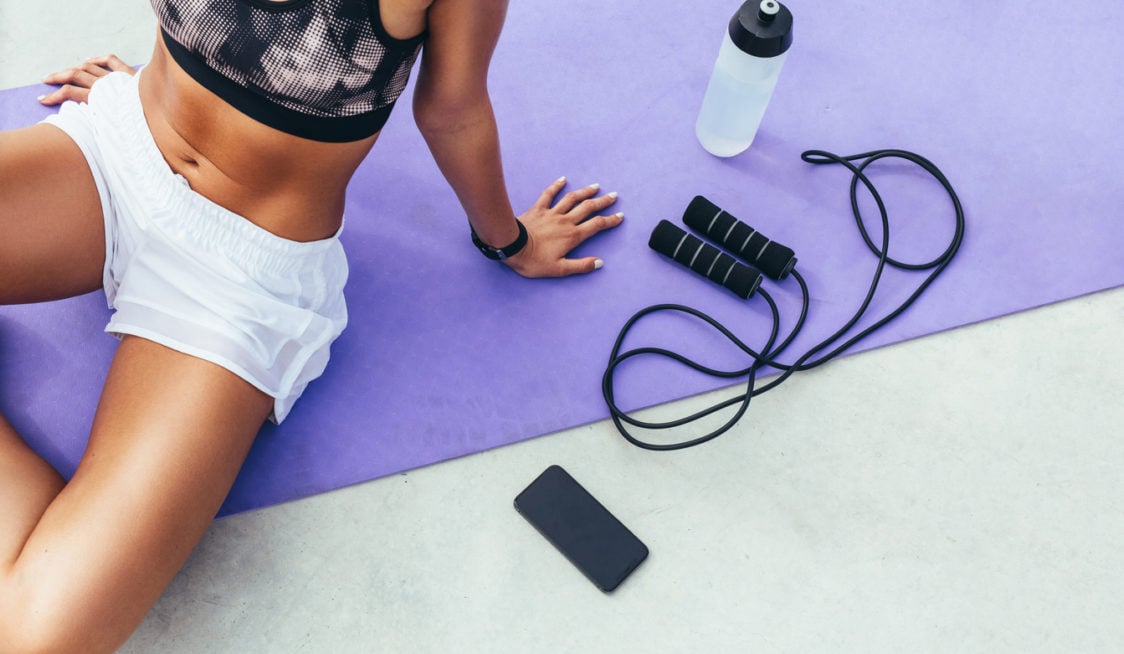
Once you are a proud owner of a skipping rope, you better make sure it’s adjusted properly. Beginners in particular should use a longer rope, as this will extend the time of a each swing and thus give them more time to coordinate their movements. Over time, you shorten rope’s length as needed. To adjust the length of the rope, stand on it with your feet next to each other, grab the handles, straighten up and pull the rope alongside your body to the height of your shoulders. The length of the skipping rope should reach up to the height of your armpit. [22]
Beginning to skip
Once your rope is set up properly, you can start training. It is crucial to start learning the proper technique right away in order to protect your ankles and knees, as well as the entire musculoskeletal system. Let’s go.
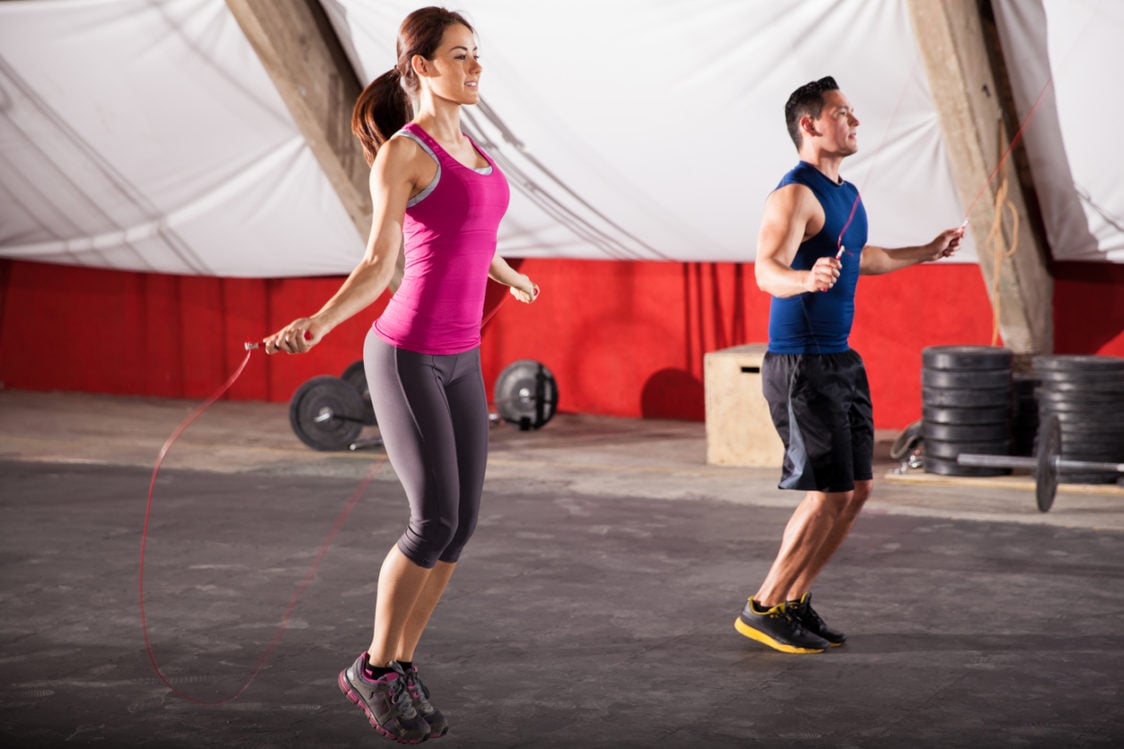
- Grab your new training buddy by its handles, place it behind you, straighten up and keep your back straight during the entire time of skipping. The first swing is done by dynamic rotation of your wrist forward. You might need to involve your entire arms at first, but eventually, with regular training, you’ll be able to handle the rope simply by moving your wrists.
- Once the rope flies over your head, bend your knees lightly, and as it approaches your feet, jump. Beginners usually tend to jump up too high at first, but it’s only a matter of time before you find yourself levitating just a few millimeters off the ground, just like Rocky Balboa.
- Make sure you make contact with the ground using only the front of your feet. This will keep you in a regular rhythm and in good speed. Try to make your feet land as softly as possible, so that your legs don’t have to absorb intense shocks.
- Once you’ve learned the basics of skipping technique, you can start learning more advanced “tricks” such as double or even triple-unders, switching your feet, or skipping on a single foot.
- Don’t overdo it from the beginning of your learning process. You don’t want to end up injuring your ankles, heels, calves or hips. [23–24]
The most common mistakes to watch out for
When skipping, watch out for the following mistakes. If you catch yourself making these, try to correct them as soon as you can:
- Moving your arms too much – ideally, you want to work your wrists only.
- Jumping way too high up – keep your feet close to each other and make sure you land on the front. Try keeping a steady rhythm.
- Wrong length of the rope – maybe you need a longer one.
- Your hands are too far away from your body – keep your hands close to your hips.
- Your rhythm is off – try counting skips or listening to your favourite song.
- Improper grip – don’t be afraid to grip those handles really tight.
- Unsuitable rope – maybe your skipping experience isn’t going as smoothly as expected. Try borrowing another type of skipping rope from a friend. You might find it more comfortable. [25–26]
How to incorporate the skipping rope into your training?
Even if you’re massively motivated at the beginning of your skipping journey, that’s no reason to substitute all of your training for skipping rope. The best thing you can do is make it a part of your warmup or a sequence in your interval training.
What does a training plan including a skipping rope look like?
- Jump rope workout– plan the amount of reps or time of the sets. For example – 1 minute of skipping, 30 second pause, etc. To add extra intensity to the exercise, use a weighted vest or a weighted rope.
- EMOM – set up a time – let’s say, 20 minutes. At every started minute you’ll do 50 skips, and after completing these, you’ll rest for the remaining portion of the minute until the start of the next one.
- Combining with less intense exercise – switch in between skipping and, for example, strength training.
- As a warm up – a two-minute skipping session will get your body into a good training temperature.
- Interval training such as tabata or HIIT – try adding rope skipping into your interval training, e.g. by skipping for 30 seconds and resting for 30 seconds.
- Circuit training – set up a series of exercises including rope skipping, and move from station to station (exercise to exercise). [27–28]
Examples of training with the skipping rope
You can either try interval training, in which the skipping rope is one of the 5 pre-set exercises, or EMOM, that’s all about the skipping rope. Before training make sure to warm up, do some dynamic stretching and after the main part of the training, stretch lightly in a static manner.

- Full-body interval workout
- 30 seconds of skipping, 30 seconds break
- Shoot for 3 to 5 series
- Longer break in between the series – 60 to 90 seconds.
Exercises:
/Verywell-42-3498282-Pushup01-1596-5994a0f8519de20010b3bdd3.gif)
2. Intense EMOM training with a skipping rope
- Duration of the training: 12 minutes
- Cycle through 4 exercises with the skipping rope
- 30 – 50 reps at each started minute
- Break for the rest of the minute after finishing the reps
Exercises:
- basic rope skips
- single leg rope skips
- skipping on the alternate leg
- switching feet
Take home message
The skipping rope is a widely available exercise tool that you can easily take everywhere you go. It offers a number of benefits for your mental and physical health. It is great for improving fitness, losing weight and even for improving your mood, thanks to how effective skipping exercise is at releasing endorphins. Skipping can fit into almost any workout plan. If you haven’t had a rope in your hands since your childhood, give it a second chance and skip your way into a healthier lifestyle.
What’s your opinion on skipping rope workouts? Is it just a children’s toy, or does it deserve a warm spot in the training plans of every one of us? Share your experience in the comment section, and if you liked this article, share it with your friends on social media, so that they also get to reminisce about their PE classes at school, and perhaps give another chance to this great fitness tool.
[1] Conditioning Exercise—Compendium of Physical Activities. – https://sites.google.com/site/compendiumofphysicalactivities/Activity-Categories/conditioning-exercise
[2] KalorickéTabulky.cz.– https://www.kaloricketabulky.cz/user/diary
[3] Healthline. Jumping Rope to Lose Weight: Is it Effective? https://www.healthline.com/health/jumping-rope-to-lose-weight
[4] Verywell Fit. Pairing Cardio and Weight Training for Maximum Fat Loss. – https://www.verywellfit.com/cardio-and-weight-training-and-fat-loss-3498325
[5] Seo, K. The effects of dance music jump rope exercise on pulmonary function and body mass index after music jump rope exercise in overweight adults in 20’s – https://doi.org/10.1589/jpts.29.1348
[6] Davies, D. Can skipping ropes build muscle? – http://www.menshealth.co.uk/building-muscle/a759175/does-skipping-build-muscle/
[7] The Beachbody Blog. What Muscles Does Jump Rope Work? – https://www.beachbodyondemand.com/blog/what-muscles-does-jump-rope-work
[8] SimpliFaster. A Case for Skipping Rope in Sports Training. – https://simplifaster.com/articles/skipping-rope/
[9] Ozer, D., Duzgun, I., Baltaci, G., Karacan, S., & Colakoglu, F. The effects of rope or weighted rope jump training on strength, coordination and proprioception in adolescent female volleyball players. – https://pubmed.ncbi.nlm.nih.gov/21681154/
[10] Kim, J., Son, W.-M., Iii, R. J. H., Pekas, E. J., Noble, J. M., & Park, S.-Y. The effects of a 12-week jump rope exercise program on body composition, insulin sensitivity, and academic self-efficacy in obese adolescent girls. Journal of Pediatric Endocrinology and Metabolism. – https://doi.org/10.1515/jpem-2019-0327
[11] Partavi, S. Effects of 7 weeks of rope-jump training on cardiovascular endurance, speed, and agility in middle school student boys. – https://www.sposci.com/PDFS/BR0602/SVEE/04%20CL%2007%20SP.pdf
[12] Kirthika V, S., & Selvam, S. The Effect of Skipping rope Exercise on Physical and Cardiovascular fitness among Collegiate Males. – https://doi.org/10.5958/0974-360X.2019.00836.9
[13] Grab a rope:seven reasons why skipping is so good for you. – https://www.herts.ac.uk/about-us/news-centre/news/2020/grab-a-ropeseven-reasons-why-skipping-is-so-good-for-you
[14] Umemura, Y. The effects of jumping exercise on bones. [https://doi.org/CliCa17016772
[15] Tucker, L. A., Strong, J. E., LeCheminant, J. D., & Bailey, B. W. Effect of two jumping programs on hip bone mineral density in premenopausal women. – https://doi.org/10.4278/ajhp.130430-QUAN-200
[16] ACE Fitness.7 Benefits of Jumping Rope – https://www.acefitness.org/education-and-resources/lifestyle/blog/6395/7-benefits-of-jumping-rope/
[17] WebMD. Exercise and Depression. – https://www.webmd.com/depression/guide/exercise-depression
[18] Pain and Stress: Endorphins: Natural Pain and Stress Fighters. – https://www.medicinenet.com/endorphins_natural_pain_and_stress_fighters/views.htm
[19] Shaw. Jump Rope Workouts: Intense, Affordable, and Easy. – https://www.webmd.com/fitness-exercise/a-z/jump-rope-workouts
[20] Velites Sport Blog. Step by Step GUIDE to choose the BEST Jump Rope for You. Guaranteed. – https://en.velitessport.com/know-jump-rope-need-ultimate-guide/
[21] Openfit. 8 Best Cordless Jump Ropes for 2021. – https://www.openfit.com/cordless-jump-rope
[22] BuyJumpRopes.Net. Jump Rope Length—Most Accurate Sizing Method – https://buyjumpropes.net/resources/jump-rope-length
[23] Men’s Health. What’s the best way to jump rope for cardio? https://www.menshealth.com/fitness/a19535726/jump-rope-cardio/
[24] DMARGE. Learn To Jump Rope Like An Expert From The Man Who Trains The US Olympic Team.– https://www.dmarge.com/2020/04/skipping-rope-workout.html
[25] Crossrope. Common Jump Rope Mistakes (And How to Fix Them). – https://www.crossrope.com/blogs/blog/jump-rope-mistakes
[26] Janine Delaney Wellness Coach. Why You Keep Tripping Over Your Jump Rope. – https://janinedelaney.com/why-you-keep-tripping-over-your-jump-rope/
[27] How to Jump Rope in 4 Easy Steps: Jump Rope Workouts. – https://www.insider.com/how-to-jump-rope
[28] SimpliFaster. A Case for Skipping Rope in Sports Training | – https://simplifaster.com/articles/skipping-rope/
Add a comment