
Table of Contents
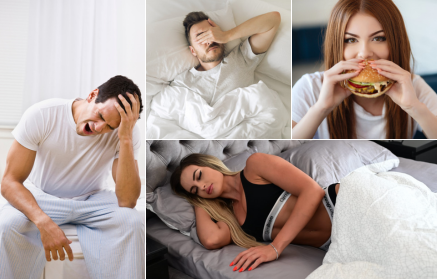
At first glance, the link between sleep and body weight may not seem straightforward. However, anyone who has experienced the day after a sleepless night knows that, in addition to fatigue and laziness, they felt more like eating. After a poor night’s sleep, it’s most comfortable to curl up on the sofa and reach for snacks. Globally, sleep quality is getting worse. Artificial lighting contributes to this, as does constant staring at screens. It is no wonder, therefore, that more and more people with poor sleep quality are becoming overweight and obese.
How does short sleep increase the risk of overweight and obesity?
It makes a big difference whether we sleep badly once or sleep badly on a regular basis. One day of acute sleep deprivation doesn’t have to spell disaster. What’s worse is chronic sleep deprivation. People whose sleep is inadequate, and therefore regularly less than 6-7 hours, are more prone to gain weight. We have evidence of this from many studies that show that BMI of people who sleep little is higher than the BMI of people who regularly sleep at least 8 hours [1].
A 2017 meta-analysis published in the European Journal of Clinical Nutrition (EJCN) showed that people with sleep deprivation eat an average of 385 kcal more per day than people with normal sleep [2]. Why is this so? The answer is found in the hormonal changes that occur when the body requires more rest than it has been provided with. These hormonal changes force our tired brains to seek more food than necessary. With chronic sleep deprivation, this overeating will also be reflected in body weight.

1. Hormonal imbalance
The hormones most disrupted due to lack of sleep are precisely those that tell us about hunger and fullness.
- Ghrelin is the hormone responsible for the feeling of hunger. It works very simply – if we have more of it , we feel hungry. If we have less of it, we don’t feel hungry. If we get poor or insufficient sleep, our ghrelin levels are naturally higher. That’s why we are hungrier after sleep deprivation [3].
- On the opposite side stands leptin, the satiety hormone. This is produced by fat tissue and signals the brain when we should eat more and when we’ve had enough. It also works simply – high levels signal satiety and low levels make us eat more. Its misregulation is typical in obese people, in whom the feeling of fullness comes later. They are also at risk of leptin resistance, where the brain fails to respond properly to the body’s signals and “forces” us to eat much more than necessary. In the case of sleep deprivation, its levels are lower, signalling the brain to eat more [3].
You might be interested in these products:
Sleep deprivation is also accompanied by a more active sympathetic nervous system, the one responsible for the stress response. The result is higher levels of cortisol, which, among other things, helps to store fat. Together with the impaired insulin sensitivity, the calories we take in are more readily stored where we don’t want them [4, 5].
The result is that the balance is disturbed:
- more gherlin – it tells us that we are more hungry
- less leptin – this tells us that we should eat more and we will feel fuller later
- more cortisol – fats will be stored more easily
- insulin sensitivity is impaired, which also stimulates better fat storage and increases the risk of type 2 diabetes
2. When tired, we move less
Fatigue, in addition to a lack of sleep, naturally reduces our caloric expenditure. We are much better off in the comfort of the sofa or bed, and if we have the opportunity, we conserve energy in every activity. When tired, we are also more likely to skip a planned workout or other physical activity. In the case of chronic sleep deprivation and chronic fatigue, this will reduce our caloric expenditure over the long term, which, along with increased caloric intake, will cause us to gain weight. This may appear to be a “slowed metabolism”, but it is actually a lack of activity due to fatigue.

3. Disrupted circadian rhythm
Poor quality sleep directly disrupts the natural circadian rhythm that governs the human body. This 24-hour cycle is evolutionarily set due to the length of the day on our planet. Its proper functioning is controlled primarily by hormones, including cortisol, but also melatonin. Melatonin is released during sleep. With chronic sleep deprivation, the concentration of melatonin is lower, which again results in a higher risk of obesity. This is because it has an important role in lipid (fat) metabolism and helps with the regulation of visceral adipose tissue [6, 7].
4. The biggest risk is shift work
Shift workers are constantly exposed to chronic sleep deprivation and disrupted circadian rhythm. They also have an increased risk of cardiometabolic diseases [8]. People travelling across multiple time zones suffer similarly. This is known as “jet lag”, where the body is unable to quickly readjust to a different time zone. The worst case is insomnia, i.e. chronic insomnia, which can be caused by a variety of factors.
How not to lose weight due to poor sleep?
The ideal length of sleep is to some extent individual and depends mainly on age. The general recommendation is an interval of 7 to 9 hours. Statistically, 7.5 hours of quality sleep is the healthiest [9, 10].
For the best quality sleep, it is advisable to maintain regularity, i.e. to fall asleep and get up at the same time, to keep the room at the right temperature (approx. 18°C) and to keep the light as low as possible. It is also a good idea not to use a mobile phone or other light-emitting device before going to bed. It is ideal to create our own evening routine to help us fall asleep. Sometimes it is enough to swap the mobile phone for a book in the last hours of the day .
In the case of shift work, insomnia or travelling, melatonin and tryptophan supplementation before sleep can also help. Melatonin is produced from tryptophan and helps to reduce the time it takes to fall asleep. If you’re interested in the topic of sleep and energy, we recommend reading our article Sleep: the most effective kicker and fat burner.

Conclusion
Chronic sleep deprivation literally throws the hormonal balance in the body into disarray and forces us to eat more than necessary. Together with fatigue and lack of exercise, this creates a recipe for gaining weight very easily. This is not helped by a disrupted circadian rhythm that will make fat tissue store more efficiently. For these and other reasons, sleep is one of the most important pillars of a healthy lifestyle and can be a crucial factor in the journey to your dream figure.
If you liked this article, we will be happy for any sharing. Don’t forget to let us know in the comments how many hours a day you sleep.
[1] Cooper CB, Neufeld EV, Dolezal BA, Martin JL. Sleep deprivation and obesity in adults: a brief narrative review - doi:10.1136/bmjsem-2018-000392
[2] Al Khatib, H. K., Harding, S. V., Darzi, J., & Pot, G. K. (2017). The effects of partial sleep deprivation on energy balance: a systematic review and meta-analysis – https://doi.org/10.1038/ejcn.2016.201
[3] van Egmond, L. T., Meth, E. M. S., Engström, J., Ilemosoglou, M., Keller, J. A., Vogel, H., & Benedict, C. (2023). Effects of acute sleep loss on leptin, ghrelin, and adiponectin in adults with healthy weight and obesity: A laboratory study – https://doi.org/10.1002/oby.23616
[4] Wright KP Jr, Drake AL, Frey DJ, et al. Influence of sleep deprivation and circadian misalignment on cortisol, inflammatory markers, and cytokine balance doi:10.1016/j.bbi.2015.01.004
[5] Mesarwi O, Polak J, Jun J, Polotsky VY. Sleep disorders and the development of insulin resistance and obesity. Endocrinol Metab Clin North Am. 2013;42(3):617-634. doi:10.1016/j.ecl.2013.05.001
[6] Hu, S., Liu, X., Wang, Y., Zhang, R., & Wei, S. (2022). Melatonin protects against body weight gain induced by sleep deprivation in mice. – https://doi.org/10.1016/j.physbeh.2022.113975
[7] Guan Q, Wang Z, Cao J, Dong Y, Chen Y. Mechanisms of Melatonin in Obesity: A Review - doi:10.3390/ijms23010218
[8] Schilperoort M, Rensen PCN, Kooijman S. Time for Novel Strategies to Mitigate Cardiometabolic Risk in Shift Workers - doi: 10.1016/j.tem.2020.10.005
[9] Scott, H., Naik, G., Lechat, B., Manners, J., Fitton, J., Nguyen, D. P., Hudson, A. L., Reynolds, A. C., Sweetman, A., Escourrou, P., Catcheside, P., & Eckert, D. J. (2024). Are we getting enough sleep? Frequent irregular sleep found in an analysis of over 11 million nights of objective in-home sleep data – https://doi.org/10.1016/j.sleh.2023.10.016
[10] Jin, Q., Yang, N., Dai, J., Zhao, Y., Zhang, X., Yin, J., & Yan, Y. (2022). Association of Sleep Duration With All-Cause and Cardiovascular Mortality: A Prospective Cohort Study – https://doi.org/10.3389/fpubh.2022.880276
Add a comment