
Table of Contents
There are five regions in the world where an unusually high number of people live to be a hundred years old. Many of them remain active at an age when others have long since been unable to perform basic daily activities. These places are known today as Blue Zones.
The inhabitants of these zones are not united by genetics or top-tier medicine, but by a surprisingly similar way of life. In this article, we will explain what Blue Zones are, why they work, where science has recently significantly questioned them, and which of their principles make sense to transfer to your daily life.
Quick Summary: Blue Zones and Longevity
- What are Blue Zones: Five regions of the world with an unusually high proportion of people who live to an advanced age in good health: Sardinia, Okinawa, Ikaria, Nicoya, and Loma Linda.
- What unites them: Not genetics, but a similar way of life, meaning a predominantly plant-based diet, natural movement, strong relationships, and a clear sense of purpose.
- Power 9: Nine shared habits, including the rule of eating until 80% full, a diet built on legumes, and a strong community.
- Diet: Predominantly plant-based, based on legumes, vegetables, and whole-grain foods; meat only exceptionally; water as the main beverage.
- Alcohol: A glass of wine with a meal was a habit in most zones; however, we do not recommend it today because, according to the WHO, there is no safe amount of alcohol.
- What science says: Records of people over 110 years old are often questioned, but the ages in the four main zones were confirmed by a peer-reviewed study from 2025, and life principles are also supported by independent research.
- The takeaway: Longevity is not based on a single supplement, but on a combination of small habits that last for years and can be applied even in modern life.
What are Blue Zones and why are they called that?
Blue Zones include five regions of the world with an above-average proportion of people who live to a hundred or more years in good health. These include Sardinia, Okinawa, Ikaria, Nicoya, and Loma Linda. The name Blue Zones originated quite simply: researchers marked these places with a blue pencil on a map during their research. People who live to a hundred or more years are called centenarians, and those over 110 years are supercentenarians. It is their number in a given territory that determines whether an area is considered a Blue Zone. [2,12,19]
Who introduced the term Blue Zones?
The term Blue Zones was introduced by Belgian demographer Michel Poulain and Italian physician Gianni Pes in the early 2000s while verifying centenarian residents of Sardinia. They visited mountain villages, checked birth records, and marked each village with an exceptionally long-lived population on the map with a blue circle. They then began calling the areas within these circles Blue Zones. They first used the term in the AKEA study, which they published in 2004 in the journal Experimental Gerontology. [6]

How did Blue Zones enter the public consciousness?
American journalist Dan Buettner turned the academic research into a global phenomenon. He joined the work of Poulain and Pes and, in 2005, wrote a cover story for National Geographic. He later expanded on the concept in 2008 in the book The Blue Zones and in 2023 in the Netflix documentary series Live to 100: Secrets of the Blue Zones. Buettner also expanded the original Sardinian zone to today’s five regions. [15]
What do Blue Zones have in common?
The five Blue Zones are located on three continents and are not united by a common origin, climate, or cuisine, but by similar patterns of daily life. People in them naturally move a lot, eat a predominantly plant-based diet, maintain close relationships, and have a clear sense of purpose. This is why Blue Zones are discussed in terms of lifestyle rather than a single “longevity gene.”
Where are the 5 Blue Zones located?
The five Blue Zones are located in Sardinia, Italy; Okinawa, Japan; the Greek island of Ikaria; the Nicoya Peninsula in Costa Rica; and the city of Loma Linda, California, USA. They are spread across three continents and are united only by the demographic phenomenon of longevity, not by location, climate, or cuisine. [2]
1. Sardinia, Italy: Shepherds who live the longest
Sardinia was the very first Blue Zone discovered and remains one of the places with the highest proportion of male centenarians in the world.
| Characteristics | Sardinia |
|---|---|
| Identified | 2004 (first officially identified Blue Zone) |
| Location | Barbagia / Ogliastra mountain region, central-eastern Sardinia |
| Typical diet | barley bread, legumes, wild herbs, sheep and goat cheese |
| Lifestyle | shepherding and daily walking in hilly terrain, strong family ties, humour |
| What makes it unique | highest concentration of male centenarians in the world; in the central part, approximately as many men as women live to a hundred, while elsewhere women significantly outnumber men |
[6]
2. Okinawa, Japan: Island of women who live to a hundred
Okinawa is one of the most famous Blue Zones, and it is from here that the world-famous principles of ikigai and hara hachi bu originate.
| Characteristics | Okinawa |
|---|---|
| Identified | 2004 |
| Location | Northern Okinawa, especially the villages of Ogimi and Kijoka |
| Typical diet | purple sweet potatoes (imo), tofu and soy, bitter melon (goya), seaweed, fish; meat only in small quantities |
| Lifestyle | ikigai (purpose in life), hara hachi bu (eating until 80% full), moai (lifelong circles of 5–6 friends) |
| What makes it unique | one of the highest concentrations of female centenarians in the world; however, longevity is declining due to the Americanization of the diet and rising obesity in younger generations |
[2,10,13]
3. Ikaria, Greece: The island where people forget to die
Ikaria is a Greek island where longevity is combined with a slow pace of life and a Mediterranean diet.
| Characteristics | Ikaria |
|---|---|
| Identified | 2009 |
| Location | island of Ikaria in the Aegean Sea, population approximately 8,000 |
| Typical diet | Mediterranean: olive oil, legumes, dozens of types of wild vegetables, fish, goat milk, herbal teas |
| Lifestyle | regular afternoon siesta, relaxed relationship with time, strong community |
| What makes it unique | nicknamed “the island where people forget to die”; almost a third of the population lives to their nineties |
[4,16]
4. Nicoya, Costa Rica: The cheapest longevity in the world
Nicoya is a Blue Zone where men live to an above-average age despite low healthcare spending.
| Characteristics | Nicoya |
|---|---|
| Identified | 2007 |
| Location | Nicoya Peninsula, northwestern Costa Rica (cantons of Nicoya, Santa Cruz, Hojancha, Nandayure, Carrillo) |
| Typical diet | “tres hermanas” (beans, corn, squash), tropical fruit, fish; drinking water naturally rich in calcium and magnesium |
| Lifestyle | plan de vida (purpose in life), manual labour and movement into old age |
| What makes it unique | a 60-year-old man from Nicoya is approximately 7 times more likely to live to 100 than the average Japanese man, at a fraction of the healthcare cost; the advantage mainly applies to men and stems from lower cardiovascular mortality |
[7]
5. Loma Linda, California: The only Blue Zone in the USA
Loma Linda is the only Blue Zone in the USA. Unlike the other four, it is not an area with a historically verified density of centenarians, but a community of Seventh-day Adventists whose longevity is monitored through a long-term health study Adventist Health Study. [11]
| Characteristics | Loma Linda |
|---|---|
| Identified | 2005 |
| Location | city of Loma Linda, California; community of approximately 9,000 Seventh-day Adventists |
| Typical diet | predominantly vegetarian, vegan for part of the community; nuts, legumes, whole-grain foods, water |
| Lifestyle | Saturday as a day of complete rest (Sabbath), strong religious community, mutual support |
| What makes it unique | The only zone defined not by location, but by the lifestyle of a community; the longevity of Adventists is tracked by the Adventist Health Study. |
[11]
What is Power 9? 9 shared principles of Blue Zones
Power 9 consists of nine shared habits that Dan Buettner and his team identified across all five Blue Zones. These include natural movement, a sense of purpose in life, stress management, the 80% rule when eating, a predominantly plant-based diet, moderate wine consumption, community belonging, family first, and the right circle of friends. These nine points can be summarised into four areas: how people move, where they derive purpose and peace, how they eat, and their social life. [2]
Movement and physical activity
1st principle: natural movement
People in Blue Zones do not exercise specifically in a gym, but have plenty of natural movement throughout the day. Activity is woven into their day through walking, gardening, and housework. Sardinian shepherds walk more than eight kilometres daily in hilly terrain. [2]
Purpose and attitude toward life
2nd principle: purpose in life
It is a clear reason to get up in the morning, which Okinawans call ikigai and residents of Nicoya call plan de vida. This sense of purpose is associated with a lower risk of death in large Japanese cohort studies. [8]
3rd principle: Stress management
Residents of Blue Zones perform regular daily rituals to reduce stress. These include the Ikarian afternoon siesta, the Adventist Sabbath rest, and Okinawan friends gathering for tea. [2]

Eating habits
4th principle: the 80% rule (hara hachi bu)
Okinawans also follow the rule of hara hachi bu, which means stopping eating when they are approximately 80% full. This dietary principle helps them prevent overeating. [2]
5th principle: predominantly plant-based diet
The diet of people living in Blue Zones is built mainly on legumes, local vegetables and whole-grain foods; meat is eaten only exceptionally. The common foundation of all five zones is clearly legumes. [2]
If you want to know what makes legumes so special and how they affect health, read the article 7 Best Types of Legumes: How Beans Differ from Lentils and How to Prepare Them Without Bloating
6th principle: moderate wine consumption
In four out of five zones, it is customary to have one to two glasses of wine with a meal, with the exception of Loma Linda, where Adventists do not drink. However, this principle is scientifically the most controversial of the nine today, and we do not promote it, because according to the 2023 WHO position, there is no safe amount of alcohol. [17]
You can read more about alcohol and its effect on the body in the article What Alcohol Does to Our Body and Is There Even a Healthy Dose?
Community and relationships
7th principle: community belonging
Regular participation in the life of a community, often a spiritual one, is associated with a longer life. Almost all centenarians studied were part of one, whether it was a church, a club, or a neighbourhood association. It is this regular meeting that provides support and a sense of belonging. [2]
8th principle: family first
Family forms the foundation of daily life in Blue Zones. Multi-generational households, caring for grandparents at home instead of in facilities, and strong, long-term partnerships are common, ensuring that older people do not remain alone while passing on purpose and experience to the younger ones. [2]
9th principle: the right circle of friends
A stable circle of close friends supports healthy habits throughout life. In Okinawa, this is represented by moai groups, which are five to six friends who support each other for decades. [2]

What and how do people in Blue Zones eat?
The diet in Blue Zones is predominantly plant-based and built on legumes. According to Buettner’s reviews, plant foods make up approximately 95 to 100% of the diet, with the foundation being legumes, vegetables, whole grains, nuts and seasonal fruit. Meat is consumed only occasionally and in small portions; fish is eaten several times a week. [14]
What is the ratio of plant to animal food?
Plant foods make up the majority of the diet, and meat is more of a garnish than a main course. The following table shows how often individual food groups appear in Blue Zones.
| Food | Frequency and amount |
|---|---|
| Legumes (beans, lentils, chickpeas, soy) | daily, approximately half a cup cooked |
| Vegetables including leafy greens | daily |
| Whole grains (barley, corn, oats, rice) | daily |
| Nuts | daily, approximately two handfuls |
| Fruit | daily, according to season |
| Fish | approximately 2 to 3 times per week, small portions |
| Meat including poultry | approximately 5 times per month, portion 60 to 85 g |
| Eggs | approximately 2 to 4 times per week |
| Dairy products | mainly sheep and goat, cow’s milk almost not at all |
| Added sugar | significantly less than in a typical Western diet |
[14]
Which foods are most important in Blue Zones?
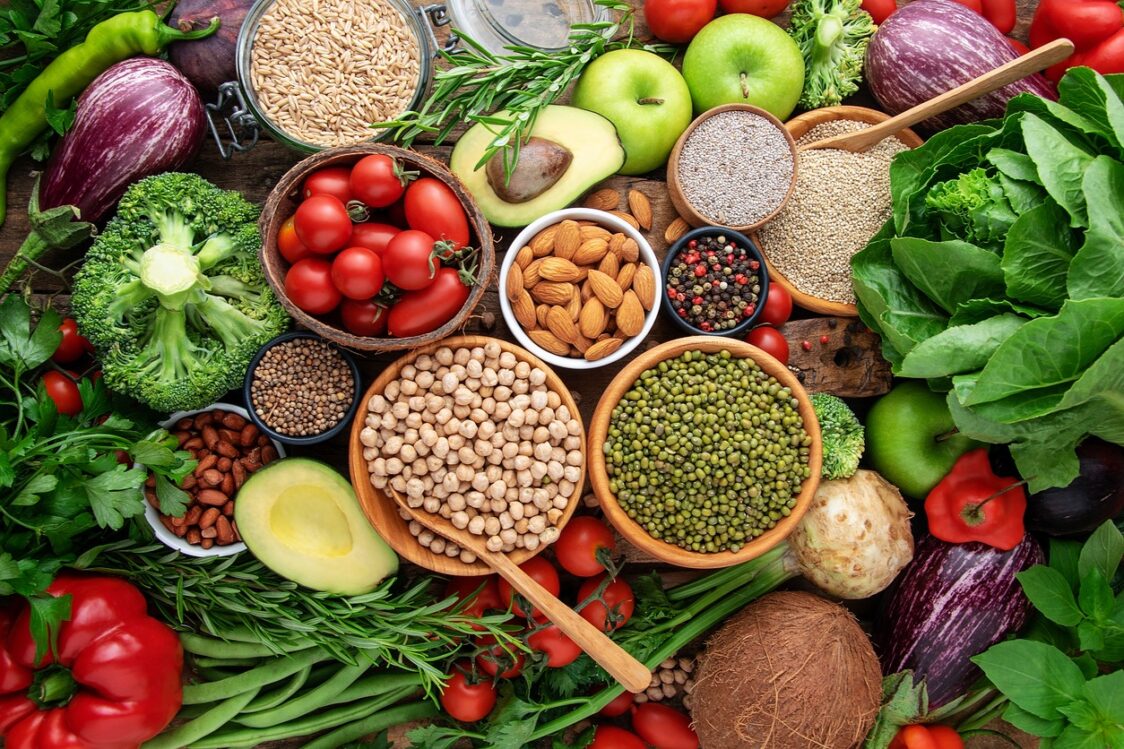
The most important food is legumes, the only food group eaten daily by people in all five zones. Each zone has its favourite, from black beans in Nicoya to soy in Okinawa to lentils and chickpeas in the Mediterranean. Other pillars include whole grains, leafy and other vegetables, nuts, and, in the Mediterranean zones, olive oil. Legumes also have the strongest scientific support. In an international study of 785 people over 70 years old, every 20 grams of legumes per day reduced the risk of death by approximately 7 to 8%. [3]
What do people in Blue Zones drink?
The main drink is water, supplemented by coffee and tea. Coffee is common in Nicoya and Ikaria, green tea is drunk daily in Okinawa, and herbal teas from wild plants are drunk in Ikaria. In addition, it is customary to drink one to two glasses of wine (everywhere except Loma Linda, where Adventists do not drink). However, we do not recommend following this last point, because according to the 2023 WHO position, there is no safe amount of alcohol. [17,14]
What is ikigai and how does it relate to longevity?
Ikigai is a Japanese term for a sense of purpose in life, loosely translatable as “a reason to get up in the morning.” In large Japanese studies, such as the Ohsaki Study, the presence of ikigai is associated with a lower risk of premature death. Ikigai combines the words iki, meaning life, and gai, meaning value or worth, and denotes the feeling that your life is worth something.
It doesn’t have to be a grand life mission; ikigai can be work, grandchildren, a garden, or morning coffee. A popular Western model depicts ikigai as the intersection of four circles: what you love, what you are good at, what the world needs, and what you can be paid for. However, this interpretation is a later Western reinterpretation, not the original Japanese concept, which is broader and not tied to work or money. [8]

How does ikigai relate to lifespan?
People with a sense of ikigai have a lower risk of premature death in Japanese cohort studies. In the Ohsaki study of 43,391 adults followed for seven years, those who did not have a sense of ikigai had approximately a 50% higher risk of death from all causes compared to those who did. The JACC study with 73,272 participants, followed for an average of 12.5 years, confirmed that the presence of ikigai is associated with a lower risk of death from all causes and from cardiovascular diseases. [8,9]
Are Blue Zones scientifically proven? Criticism and controversies
Blue Zones as a concept have faced serious scientific criticism since 2019, but the principles of a healthy lifestyle derived from them remain in line with mainstream science. The main critic is Australian biologist and demographer Saul Justin Newman, according to whom the extraordinary number of centenarians in these areas may be partly the result of errors in registries, poor birth records, and pension fraud. For this work, he was awarded the Ig Nobel Prize in Demography in 2024, which honours research that “first makes people laugh, and then makes them think.” [5]
The scientific community does not have a unified opinion on this. Demographers commonly acknowledge that age records in older and poorer populations tend to be unreliable. However, Newman’s conclusion that Blue Zones are largely a statistical error is controversial, and Blue Zone researchers strongly reject it.
What exactly does Saul Justin Newman claim?
Newman claims that areas with longevity records are often related to poverty, poor age records, and pension fraud, not above-average health. Among verified supercentenarians, i.e., people over 110 years old, he says only 18% have a birth certificate; in the USA, almost no one does, and the introduction of mandatory birth certificates is associated with a decrease in their number by 69 to 82%. In Greece, at least 72% of recorded centenarians were supposedly actually dead, missing, or it was pension fraud, and after data correction, the Nicoyan zone shrank by approximately 90%. [5]
How does science respond to Newman’s criticism?
Scientists responded to the criticism and insist that the ages of people in the four main Blue Zones are verified and reliable. The response was provided by a peer-reviewed study from late 2025, co-authored by one of the discoverers of Blue Zones. Its main idea is simple. Newman mainly questions the records of the very oldest people over 110 years old. But Blue Zones were never based on such extreme records. They are based on the fact that an unusually high number of people live to an advanced age, their nineties and hundreds, and this is a much larger group that is better captured by records. [1,20]
What from the Blue Zones then holds true and what does not?
The age in the four main zones is verified, and healthy habits from them are confirmed by other studies. But it is important to note that Blue Zones do not last forever. It is primarily the older generation that grew up on a traditional way of life that lives exceptionally long. In Okinawa, younger people have switched to a Western diet, and their longevity is declining so much that the island no longer meets the strictest criteria for a Blue Zone today. It sounds like bad news for the whole concept, but in reality, it is its strongest proof. When the traditional lifestyle disappeared, the exceptional longevity also disappeared. Therefore, it is how people live that matters, not their genes. [1]

How do Blue Zones overlap with the Mediterranean diet?
Blue Zones and the Mediterranean diet are not the same – the Mediterranean diet is a way of eating, while Blue Zone principles encompass an entire lifestyle, of which diet is only one component alongside movement, relationships, and purpose in life. They overlap precisely in the dietary part, and to a large extent, because both are built on a plant-based diet, legumes, vegetables and olive oil. In the two zones located directly in the Mediterranean (Sardinia and Ikaria), the diet of the inhabitants practically coincides with the Mediterranean pattern.
| Aspect | Blue Zones | Mediterranean Diet |
|---|---|---|
| Scope | lifestyle: diet, movement, relationships, purpose | predominantly a dietary pattern |
| Geographic area | five regions on three continents | countries around the Mediterranean Sea |
| Plant-based foundation | legumes daily | legumes several times a week |
| Olive oil | mainly in two zones (Sardinia, Ikaria) | universal foundation |
| Meat | approximately 5 times per month | less often, in small quantities |
| Strength of scientific evidence | moderately strong | very strong (PREDIMED, Lyon Diet Heart Study) |
| Origin of the concept | Dan Buettner, journalist, 2005 | Ancel Keys, scientist, 1950s |
In practice, this means that Blue Zones are a great lifestyle framework, but if you are looking for a strictly scientifically based dietary direction, the Mediterranean diet has the strongest evidence. Its beneficial effect on the heart and blood vessels has been confirmed by large studies, primarily the Spanish randomised clinical trial PREDIMED. [18]
If you are interested in the principles of the Mediterranean diet and its health effects, read our article Mediterranean Diet: A Scientifically Proven Way of Eating for a Healthy Heart, Brain, and Longevity.
How to apply Blue Zone principles in modern life?
Blue Zone principles can be applied even in modern life, without moving to an island and without exotic foods. The essence is not to copy a specific diet, but to consciously bring back into the day what Blue Zone residents have naturally – a plant-based diet, movement, close relationships, or rituals to reduce stress.
Which habits to take away from Blue Zones?
- Base most meals on vegetables, legumes, and whole-grain side dishes. Treat meat only as a supplement.
- Include legumes almost every day.
- Eat slowly and stop when you are approximately 80% full.
- Let water be the main drink instead of sweetened beverages.
- Add natural movement in the form of walking, stairs, cycling, or gardening.
- Do not sit for long periods at a time; get up every hour and take a short walk.
- Maintain regular contact with people you feel good with.
- Get involved in a community according to your interests and spend time with loved ones across generations.
- Have a specific reason to get up in the morning and a regular ritual to reduce stress.
Frequently Asked Questions (FAQ)
Dan Buettner described five Blue Zones: Sardinia, Okinawa, Ikaria, Nicoya, and Loma Linda. Four of them, except for Loma Linda, have undergone strict demographic verification; Loma Linda is a specific Adventist community in the USA.
Yes, two of the five zones are in Europe: Sardinia in Italy and Ikaria in Greece. There is no official Blue Zone in continental Europe, although scientists are studying other long-lived communities, for example in the Netherlands.
No, the diet in Blue Zones is predominantly plant-based, but not strictly vegan. Meat is eaten only occasionally, several times a month, and the diet also includes fish, eggs, or sheep and goat cheese. The exception is Loma Linda, where the diet is predominantly vegetarian.
Yes, in the four main zones, scientists have verified the age of the inhabitants and confirmed that an unusually high number of people live to an advanced age. Criticism mainly concerns world records of people over 110 years old, but the Blue Zones concept was never based on those.
In four out of five zones, a glass of wine was part of the meal, with the exception of Loma Linda, where Adventists do not drink. However, we do not recommend adopting this habit, because according to the WHO, there is no safe amount of alcohol.
The Mediterranean diet is a way of eating, while Blue Zones are an entire lifestyle. They overlap mainly in food; Blue Zones also add movement, relationships, and a sense of purpose.
Power 9 consists of nine shared lifestyle habits of people from all five Blue Zones. These include natural movement, purpose in life, stress management, the 80% rule when eating, a plant-based diet, moderate wine consumption, community, family, and a stable circle of friends. They cover four areas – movement, diet, mental well-being, and relationships. They only work as a long-term whole, not as a one-off measure.
Ikigai is a Japanese term for “a reason to get up in the morning.” In the context of longevity, it is unique because it is not related to diet or movement, yet it is associated with a longer life in Japanese studies. It can be work, grandchildren, a hobby, or anything that gives a sense of usefulness. Its essence is to remain active and needed even in old age.
The concept works. Only records of people over 110 years old are questioned, but Blue Zones were never based on those. A peer-reviewed study from 2025 confirmed the reliability of the ages of residents in the four main zones. Life principles, i.e., a plant-based diet, movement, and strong relationships, are also confirmed by independent studies.
What should you take away from this?
Blue Zones, namely Sardinia, Okinawa, Ikaria, Nicoya, and Loma Linda, show us that a long and healthy life is not based on a single miracle supplement or on genes. Their inhabitants are united by a lifestyle – predominantly a plant-based diet, natural movement throughout the day, strong relationships and a clear sense of purpose.
Some of the age data for the oldest people is subject to discussion, but the life principles themselves are confirmed by independent studies. And when these habits disappeared, as with the younger generation in Okinawa, the exceptional longevity also vanished. This is the best proof that how we live matters.
The good news is that you don’t need exotic foods or to move to an island. Just add more plant foods and legumes, move every day, eat in moderation, and maintain close relationships. The power of Blue Zones is not in one big step, but in small habits that last for years.
[1] AUSTAD, S.N. - PES, G.M. The validity of Blue Zones demography: a response to critiques. – https://pubmed.ncbi.nlm.nih.gov/41405258/
[2] BUETTNER, D. - SKEMP, S. Blue Zones: Lessons From the World’s Longest Lived. – https://www.ncbi.nlm.nih.gov/books/NBK298903/
[3] DARMADI-BLACKBERRY, I. et al. Legumes: the most important dietary predictor of survival in older people of different ethnicities. – https://pubmed.ncbi.nlm.nih.gov/15228991/
[4] LEGRAND, R. et al. Description of Lifestyle, Including Social Life, Diet and Physical Activity, of People ≥90 years Living in Ikaria, a Longevity Blue Zone. – https://pmc.ncbi.nlm.nih.gov/articles/PMC8296328/
[5] NEWMAN, S.J. Supercentenarian and remarkable age records exhibit patterns indicative of clerical errors and pension fraud – https://www.biorxiv.org/content/10.1101/704080v4>
[6] POULAIN, M. et al. Identification of a geographic area characterized by extreme longevity in the Sardinia island: the AKEA study. – https://www.sciencedirect.com/science/article/pii/S0531556504002141
[7] ROSERO-BIXBY, L. et al. The Nicoya region of Costa Rica: a high longevity island for elderly males. – https://pubmed.ncbi.nlm.nih.gov/25426140/
[8] SONE, T. et al. Sense of life worth living (ikigai) and mortality in Japan: Ohsaki Study. – https://pubmed.ncbi.nlm.nih.gov/18596247/
[9] TANNO, K. et al. Associations of ikigai as a positive psychological factor with all-cause mortality and cause-specific mortality among middle-aged and elderly Japanese people: findings from the Japan Collaborative Cohort Study. – https://www.sciencedirect.com/science/article/abs/pii/S0022399908005230
[10] WILLCOX, B.J. et al. Caloric restriction, the traditional Okinawan diet, and healthy aging: the diet of the world’s longest-lived people and its potential impact on morbidity and life span. – https://pubmed.ncbi.nlm.nih.gov/17986602/
[11] Adventist Health Study-2 | Adventist Health Study. – https://adventisthealthstudy.org/studies/AHS-2
[12] Centenarian. – https://dictionary.cambridge.org/dictionary/english/centenarian
[13] Exceptional longevity in Okinawa: Demographic trends since 1975 - Poulain - 2024 - Journal of Internal Medicine - Wiley Online Library. – https://onlinelibrary.wiley.com/doi/10.1111/joim.13764
[14] Food Guidelines – https://www.bluezones.com/recipes/food-guidelines/
[15] How the world first learned about longevity Blue Zones. – https://www.nationalgeographic.com/health/article/longevity-blue-zones-dan-buettner-archival
[16] Ikaria, Greece – https://www.bluezones.com/explorations/ikaria-greece/
[17] No level of alcohol consumption is safe for our health. – https://www.who.int/europe/news/item/04-01-2023-no-level-of-alcohol-consumption-is-safe-for-our-health
[18] Primary Prevention of Cardiovascular Disease with a Mediterranean Diet Supplemented with Extra-Virgin Olive Oil or Nuts | New England Journal of Medicine. – https://www.nejm.org/doi/full/10.1056/NEJMoa1800389
[19] Supercentenarian. – https://dictionary.cambridge.org/dictionary/english/supercentenarian
[20] The Science Behind Blue Zones: Demographers Debunk the Critics – https://danbuettner.com/the-science-behind-blue-zones/